• Home
  • Popular Topics
    • Papillons
    • Alaskan Klee Kai
    • Hiking with Dogs
    • Dog DIY
    • Recipes
    • Dog Product Reviews
    • Can Dogs Eat…
    • Dog Health
  • The Paw Pack
    • Kitsune (2008 – 2024)
    • Fenrir
  • Policies
    • Disclaimer
    • Privacy Policy
    • Work with Us
    • Site Map
  • Contact

Paw Print

    Dog Health, Pet Tips

    Why I Don’t Generally Recommend Specific Dog Foods

    September 23, 2022

    I don’t write about what I feed my dogs all that often here.  Seems strange for a pet blog right?  When I do touch upon the topic of pet food, I usually try to stay away from strongly promoting any one specific brand or pushing the foods I feed my own dogs.  Even so, by far the most common question I get whenever I do write about food or pet nutrition is “well what do you feed your pets?“.  I don’t mind answering, especially since I do put a lot of time and research into feeding my dogs, but I always make it a point to tell people that they need to do their own research and determine for themselves what the right food for their pet is.  I don’t usually offer specific dog food recommendations, at least not without asking a lot of questions first!

    Post Contents:

    • 1 There’s no one perfect dog food out there!

    • 2 Each dog an individual.  The people they live with, and their living situations are too!
    • 3 When it comes to feeding our pets, each of us has to do the best we can!
    • 4 It’s very important for owners to actually research their animals’ diets. 

    There’s no one perfect dog food out there!

    dog food recommendationsI can tell you what works for my own dogs.  I can tell you how to recognize a higher quality commercial food.  But I can’t tell you with 100% certainty that the foods I’m telling you about will work for your pet.

    Dogs are each individuals.  While they may all have the same basic nutritional needs, there’s no one food that each and every dog out there will do amazing on (wouldn’t that make pet keeping so much easier if there was).  Some dogs (like my Kitsune) suffer from food allergies.  Some just don’t like certain foods.  Or have medical conditions, sensitive stomachs, the list goes on.  Some owners have the time to research and prepare homemade diets, others don’t.

    Each dog an individual.  The people they live with, and their living situations are too!

    Dog food recommendations can sometimes be useful, but not everyone has the time, ability, or motivation to spend hours researching then implementing home prepared diets.  Not everyone can afford to buy their dogs fresh foods or higher quality kibbles.  Some people might not have the freezer space required to economically feed a raw diet, or easy access to certain foods.  Does this mean these people shouldn’t own dogs?  My opinion is that, with so many domestic pets ending up in shelters/rescues these days, I’d rather see a dog in a happy home eating a lower quality diet than living in a shelter cage or getting euthanized.

    When it comes to feeding our pets, each of us has to do the best we can!

    We should take into account factors such as our dog’s individual needs and preferences, our own schedules, budgets, and abilities, and our individual living situations.  Personally I do feed my dogs a home prepared diet, but I don’t judge people who don’t.  If someone asks me what dog food I recommend I’ll tell them about raw and home cooked diets, but I’m very understanding of people who can’t or won’t feed their pets this way.  Feeding a poorly researched and/or unbalanced home prepared diet can easily lead to health issues.  It’s not the type of thing you want to do if you’re not 100% committed to doing it right.  Feeding a high quality, balanced commercial food is better than feeding an unbalanced home prepped diet.

    It’s very important for owners to actually research their animals’ diets. 

    Don’t just opt for the cheapest bag of kibble in the store because it’s cheap, or feed a certain brand because someone else told you their dog does well on it.  Take some time to learn what makes a good, high quality food.  Look at what options exist within your budget.  Not all brands of food are created equal, even ones that are within the same price range.  A healthy diet is so important, after all, and it’s our job as animal guardians to always do the best we can to take optimal care of our furry companions.


    dog food recommendations

    Pet Tips

    Submissive Urination in Dogs

    September 22, 2022

    Submissive urination is, thankfully, something I haven’t had to personally deal with with my current two dogs, Kitsune and Fenrir.  That’s not to say that I haven’t experienced this issue before.  My family’s dog when I was a kid, a black and white cocker spaniel named Naomi, used to do this quite frequently.  What, exactly, is submissive urination and what can you do to avoid it?  Read on to find out!

    What is Submissive Urination?

    Submissive Urination Dogs

    Photo credit: stephzerofour This file is licensed under the Creative Commons Attribution-Share Alike 2.0 Generic license.

    Submissive urination is when a dog urinates to show that it’s not a threat.  This behavior is rather common in puppies, but, luckily, most dogs grow out of it as they get older. 

    Not all dogs who have accidents do so for this reason.  If you’re unsure about whether your dogs bathroom issues are submissive behaviors, or something else, it’s best to speak with your vet.  There are health issues, such as urinary tract infections and spay incontinence, that can cause dogs to begin urinating where they are not supposed to.

    Dogs who submissively urinate do so most frequently when they are being greeted (by people or other dogs), when startled (ex. by a loud or unfamiliar sound), and when being reprimanded.  When attempting to determine if your dog is submissively urinating, or if something else is going on, it’s important to watch your dog’s body language.  Submissive urination is normally accompanied by submissive body language such as cowering, rolling over onto their back, tucking their tail between their legs, etc.  This behavior is most common in dogs who remain shy, anxious, and/or timid into adulthood.

    How to Resolve Your Dogs Submissive Urination.

    If you and your vet have ruled out other causes, and your dog is having issues with submissive urination, there are some things you can try to discourage the behavior.  Keep greetings low key, especially when introducing new people/animals to your dog.  Avoid speaking in a loud voice and wait until your dog calms down a bit before approaching and petting him/her.  During times of stress, ask your dog to sit or preform other simple tricks so they can focus on your commands rather than on the excitement of what’s going on around them.

    Speak to your dog calmly and never yell at, hit, or otherwise punish your dog.  Doing so, especially with a dog who is already anxious, harbors fear.  We want our dogs to trust and respect us.  If your dog does have an accident remember that it’s ok.  Accidents happen.  Clean it up well with an enzymatic cleaner or some vinegar, and move on.  Work on building up your dog’s confidence by slowly exposing him to new people/situations in a calm, fun, stress free manner.

    I know that dealing with a dog who uses the bathroom in unappropriated places can be frustrating.  But don’t give up!  And don’t be afraid to seek out the help of professionals if you’re feeling overwhelmed dealing with this, or other issues, on your own.

    Submissive Urination Dogs

    Dog Health

    The Benefits of Giving Dogs Turmeric (Golden Paste)

    September 21, 2022

    pppp

    Post Contents:

    • 1 Turmer- What!?
    • 2 What is Turmeric?
    • 3 So How is Turmeric Relate to Dogs?
    • 4 How Much Turmeric Can Dogs Have?
    • 5 Turmeric Cautions
    • 6 What is “Golden Paste”?
    • 7 Our Experiences with Turmeric

    Turmer- What!?

    Despite buying turmeric as a seasoning for my own food, and using it for my dogs, I’m still never 100% convinced that I’m pronouncing it correctly!

    What is Turmeric?

    Many people probably think of turmeric as a food seasoning.  It’s a plant in the ginger family.  Native to the Indian subcontinent and Southeast Asia, the rhizomes of the turmeric plant are commonly ground for use in cooking.  Popular in curry recipes, turmeric is described as having an earthly, bitter flavor.  The ground plant has a vibrant orange color that can also be used to dye things, or as a food colorant.  Be careful when using turmeric, as that lovely golden orange color can stain surfaces!

    Turmeric, by means of one of it’s main components, curcumin, is touted as having a plethora of health benefits – everything from reducing dental plaque to fighting cancer!

    So How is Turmeric Relate to Dogs?

    benefits dogs turmericThe curcumin in turmeric is thought to have anti-inflammatory and antioxidant properties.  There are SO many dog health conditions that cause painful inflammation.  Many owners swear by supplementing with turmeric (via something called “golden paste”, more later) to treat conditions such as arthritis, joint issues, GI issues, allergies, general pain, and more!  Turmeric is also thought to benefit dogs’ skin and coat health.  In a 2014 study done with humans, it was concluded that turmeric “extracts are as  effective as ibuprofen for the treatment of knee osteoarthritis.”  In fact, patients treating osteoarthritis reported less GI related side effects than patients using ibuprofen.

    Curcumin is also said to have antioxidant properties.  Studies have suggested that curcumin has cancer fighting properties, although further testing is needed.

    Pain medications for dogs, especially NSAIDs, are notorious for potentially causing quite a few negative side effects.  These can include things like vomiting, diarrhea, depression, loss of appetite, intestinal ulcers, liver failure, and kidney failure.  It makes sense why owners with dogs who have chronic, painful conditions, such as arthritis, would want to look for alternative treatments for their pet’s pain.  Nobody wants to see their animal companion in pain, but the thought of side effects like kidney failure is scary too!

    How Much Turmeric Can Dogs Have?

    The recommended dosage of turmeric for dogs is 15mg to 20mg per pound, once a day.  This equals out to 1/8 to 1/4 of a teaspoon per pound.  However, it’s a good idea to start with a smaller dose and work your way up, to asses how your dog handles turmeric.  I’d start with a half, or even a fourth, of your dog’s dosage and then increase the amount given slowly over time.  Turmeric leaves the body quickly, so breaking up your dog’s daily dosage into smaller dosages throughout the day can be beneficial.  For example, rather than giving your dog their full dose with breakfast, break it up and give them half in the morning and half in the evening.

    Turmeric Cautions

    Turmeric can cause GI issues, including upset stomach and constipation.  This is why it’s recommended to start at a lower dose and work your way up.  Turmeric can cause issues for dogs who are prone to developing kidney stones, as it can increase urinary oxalate levels.  Especially if your dog is on any medications, always discuss any new supplements with your vet.  Turmeric can interact with some prescription medications, including diabetes medication and anti-inflammatories.  It’s also not advised to give turmeric to dogs who are scheduled to have any kind of surgery, because turmeric acts as a natural blood thinner.

    What is “Golden Paste”?

    Turmeric is available as supplements for dogs for those who don’t want to worry about preparing/dosing it on their own.  However, the curcumin in turmeric is not easy for the body to absorb on it’s own.  The bioavailability of curcumin greatly increases if it’s taken with fats, and black pepper.  A substance in black pepper called piperine helps the body to better absorb curcumin.

    The recipe for golden paste that I use is 1/2 cup high quality turmeric powder, 1 cup water, 1/4 cup coconut oil, and 1 1/5 teaspoons ground black pepper.  I heat the ingredients on low heat and mix until everything is well blended and the mixture is uniform.  Then I store it in a mason jar in the refrigerator.

    The pepper and coconut oil in golden paste helps the body to better absorb and utilize the curcumin in turmeric.

    Our Experiences with Turmeric

    benefits dogs turmericI am not currently giving my dogs turmeric.  My dog that it benefited the most, Kitsune, is currently on a few medications thanks to a recent IVDD flare.  One of his medications is an anti-inflammatory.  Our vet recommended we stop using golden paste until after Kit is off his medications.

    When Kit was taking turmeric, I do feel that I saw several benefits.  It seems to have helped his teeth and GI issues.  For years now I’ve struggled to keep Kit’s teeth healthy.  Although I feed him raw meaty bones and brush his teeth, his teeth have always been prone to plaque buildup.  I didn’t know, at first, that turmeric could help fight plaque buildup.  I was surprised when his teeth started looking better and better, despite no extra effort on my part.

    Kit has also always had somewhat of a sensitive stomach.  Not to go into too much detail, but he’s prone to often experiencing softer than normal poop.  Turmeric did seem to help him with this!

    When he can have them, I make Kit golden paste treats.  As I mentioned above, we’ve had to take a break from giving Kitsune turmeric lately, but I hope to be able to start him on it again eventually.  I’m planning on sharing a more in depth post about my golden paste recipe, as well as my golden paste treat recipe soon!

    I’d love to hear from you!  Have you ever used turmeric as a supplement for yourself or your pet?  If so, what where you’re experiences with it like?

    benefits dogs turmeric

    Pet Tips

    Dog Parks – Love ‘Em or Hate ‘Em?

    September 20, 2022

    I think Kitsune, Fenrir, and I are still on the fence (pun intended) about what we think of dog parks.  I know they can be great places for dogs to play and socialize.  Especially so for city dogs who might not have yards of their own.  However, I’ve heard plenty of dog park horror stories.  I understand why some owners would want to stay away from dog parks.  What do you think?  Do you (and your dog) love dog parks, hate them, or do your opinions fall somewhere in between?  This post includes our list of dog park pros and cons.

    dog park pros cons

    Photo Credit: AITFFan1 Licensed under the Creative Commons Attribution-Share Alike 4.0 International license.

    This post was original published on 6/10/2014.  It was last updated on 9/20/2022.

    Kitsune used to love all other dogs, but due to a few unfortunate events he’s now weary around some dogs.  Back when we still lived in the city, we’d come across other dogs often.  Unfortunately, a few bad encounters left Kit understandably nervous around dogs who are larger than he is.  I know some dog parks have different sections for large and small dogs, but the dog park near us didn’t.

    There are some very valid reasons why responsible dog owners may choose to forgo allowing their furry friends to play in dog parks.  Here are some of them…

    Dog Park Cons:

    • Potential for injury: Accidents happen, even to the most well intentioned dog owners.   Especially when you have large groups of dogs, there is always the possibility that someone (dog or human) could get hurt.
    • Spread of disease: Unfortunately not all dog owners are as responsible as most Paw Print readers are.  When you have large groups of dogs all together in one place, you increase the chance that one (or more) of them may be sick, have parasites, etc.  It would be a shame for an afternoon of playing to result in your dog getting sick.
    •  Uneducated owners: Not everyone is an expert on dog behavior.  Some owners may not know what type of play is appropriate for a dog park, and what is not.  Some owners may not be able to read their dogs well, to know if they are getting anxious or if their dog is upsetting others.
    • Stress: While dog parks are meant to be fun, they can sometimes cause undo stress to dogs who may not be 100% comfortable around groups of other dogs.  It’s important to watch out for signs that your dog may be stressed.

    But of course, there are also some awesome reasons why some dog owners love frequenting dog parks.  Here are some of them…

    Dog Park Pros:

    • Exercise: No matter how energetic you might be, I think all dog owners experience days when they just can’t seem to keep up with their pup.  Bringing your dog to a dog park can be a great way to allow your dog to burn off some energy without having to necessarily work up a sweat yourself.
    • Mental stimulation: Being able to explore a new area and interact with other dogs can be a great way to stimulate your dog’s mind.  Don’t forget, keeping your dog mentally engaged is just as important as making sure he/she gets enough physical exercise!
    • Socialization:  Dogs are pack animals, and thrive on socializing with not only other dogs, but with people as well.  Dogs who are well socialized are less likely to act aggressively when they encounter other dogs in their everyday lives.  Dog parks can be great places for people to socialize as well!
    • Fun: For dogs and their owners, as long as owners are responsible and dogs well behaved, dog parks can be a lot of fun!   It can be a great place to unwind after a long day, spend time outdoors, and bond with not only your own pet but with other like minded people and their pets as well.

    dog park pros and consIf you decide to frequent dog parks with your dog, always make sure to supervise them closely.  Let them enjoy interacting with other dogs, but be prepared to leave early if the situation warrants it.


    My Current Stance on Dog Parks:

    I’d never judge another owner for responsibly using a dog park.  As you see from the list above, there are pros as well as cons to visiting a dog park.  I’ve decided that for me and my dogs, dog parks are just not for us.  After raising my dogs in the city, I’ve had too many negative experiences with unknown dogs to feel comfortable letting my dogs be in a pen full of them.  I’ve seen, first hand, how irresponsible, whether intentionally or unknowingly, other dog owners can be.  My dogs are both smaller breed dogs too.  I feel like makes them more likely to get hurt especially if a negative encounter involved a dog, or dogs, larger than them.

    I very much prefer to allow my dogs to socialize with dog friends who we are familiar with.  It keeps everyone safer when we know that all dogs involved are healthy and friendly, and that they have compatible play styles.

    What do you think?  Do you (and your dog/s) enjoy the dog park, or do you generally avoid them?  Did I miss any important dog park pros or cons?  Comment below!

    dog park pros and cons

    The Paw Pack, Fenrir, Kitsune

    5 Little Known Facts About My Dogs

    September 19, 2022

    Dogs can be amazingly quirky creatures!  The Paw Print dogs are no exception.  Despite being raised together, in the same conditions, using the same methods, they each have a personality uniquely their own.  I write about my dogs a lot here, but I feel like lately I’ve been focusing quite a bit on reviews and educational posts.  Today I wanted to do something different – something lighthearted and fun.  I’m going to share five little known facts about each of my dogs!

    Post Contents:

    • 1 Kitsune
    • 2 Kitsune is a doggy genius!
    • 3 Kit can be a bit of a divo dog.
    • 4 Kit’s best dog friend, other than his brother Fen, is a cute little Pomeranian.
    • 5 Ever since he was a puppy Kit has had this weird obsession with cleaning ears.
    • 6 Both of my dogs have middle names!
    • 7 Fenrir
    • 8 Fen is….not the smartest dog in the world.
    • 9 Fen loves tennis balls!
    • 10 Bellybuttons are to Fen what ears are to Kit.
    • 11 Fen is an…interesting…snuggler.
    • 12 Fen’s full name is Fenrir Snowsong.

    Kitsune

    Paw Print DogsOf course I have to start with Kitsune!  He’s the older of my two boys, at 13 years old, and I consider him to be my first dog.  My family did have a dog when I was a kid, but I wasn’t really the one responsible for caring for her.  When my partner and I got Kit, it was our first time caring for a dog all on our own.

    For anyone who doesn’t know, Kitsune is a papillon.  Well…he’s a “reject” papillon.  He’s a pretty far cry from the papillon standard, looks wise at least.  He’s oversized, mismarked, and has one ear that usually likes to flop over while the other one stands.  I also keep his hair trimmed short, which isn’t very typical for the breed.  Kit will never win any dog shows, but he’s completely won over my heart and, if you ask me, that’s a much bigger victory.  Here are five facts that even frequent readers might not know about Kitsune!

    Kitsune is a doggy genius!

    He’s amazingly smart.  I work hard to keep his mind engaged because if I don’t, and he gets bored, he’s prone to using those smarts to get himself into trouble.  Kit almost always learns new tricks in just one training session, and in 13 years I haven’t been able to find any kind of puzzle toy that can keep him occupied for long.

    Kit can be a bit of a divo dog.

    He hates getting his paws wet, for example, which is a bit funny considering how much he loves going to the beach.  He sleeps in bed with my partner and I, and will wake one (or both) of us up if the bed situation isn’t just the way he likes it.  Sometimes he just wants to be covered up, or to snuggle next to one of us.  If he decides that he doesn’t have enough room in bed he’ll wake me up and ask to go outside.  When I get up to get ready to take him out he promptly jumps into bed and takes over my spot.

    Kit’s best dog friend, other than his brother Fen, is a cute little Pomeranian.

    He gets SO excited when he sees his friend.  Kit was actually attacked by a big dog when he was a puppy, and ever since he hasn’t been crazy about large dogs, especially large brown dogs.  Strangely enough, though, his second best friend in our neighborhood is a huge great Dane.

    Ever since he was a puppy Kit has had this weird obsession with cleaning ears.

    If you got ears, he’ll clean ’em for ya!  Human, dog, rabbit, he doesn’t care what species you are.  He is not at all a fan of my ear piercings, and likes to gently try to pull them out.

    Both of my dogs have middle names!

    Although I often refer to Kitsune as just “Kit”, his full name is Kitsune Trouble.  Yes, his middle name IS Trouble!

    Fenrir

    Paw Print DogsI knew I wanted a second dog pretty quickly after we got Kitsune.  We waited 7 years before we found our Fen, though.  Fen is currently 7 years old.  He’s a miniature sized, bieyed, grey and white Alaskan Klee Kai.  Fen sometimes looks larger than he is in photos, especially if there’s nothing in the picture to compare his size too.  He weighs 18 lbs.

    Fen is an amazing little dog when it comes to his pack, but he takes a really, really long time to warm up to anyone he doesn’t know.  He’s also a very high strung little guy, and gets overstimulated pretty easily.  I’ve been working on these issues with Fen since he was young and, little by little, he’s shown a lot of improvement.  He’s a total mommy’s boy and, although he clearly also loves my fiancé too, he’s picked me to be his special person.  I think he’s pretty great too.  Here are five facts about Fenrir that my readers might not already know!

    Fen is….not the smartest dog in the world.

    It’s kind of hard for me to judge how smart he is (uh..or isn’t) when the only other dog I have to compare him to is Kit (again, doggy genius).  Fen often takes a really long time to learn new things.  A really long time.  I don’t even want to admit how long it took me to fully potty train him.  It’s weird because I can try so hard, for so long, to teach him something and he’ll just not seem to understand.  Then, one day, it just clicks, and from then on he’ll remember whatever it was I was trying to teach him.  He’s so different from Kit in this respect, and takes a lot more work to train, but always gets things eventually.

    Fen loves tennis balls!

    His favorite thing ever is playing fetch.  If he finds a stray ball outside he makes it his mission to carry it all the way home, no matter how far from home we are.  He refuses to let me help him, he always wants to carry it all by himself.  Thanks to Fen, and to the fact that we live quite close to a tennis court, our house has become the home for wayward balls.  I think about a million of them are currently under my couch.

    Bellybuttons are to Fen what ears are to Kit.

    Yes, Fen likes to clean peoples’ bellybuttons.  Why yes, it is rather awkward.  Especially since he’s quite single minded when he decides someone needs a good bellybutton cleaning.  He’ll actually try to pull their shirt up on his own.  Dogs are so weird.

    Fen is an…interesting…snuggler.

    He likes to snuggle with peoples’ heads.  If you’re sitting up he’ll drape himself around your neck like a Fen scarf.  If I’m laying down he’ll snuggle up in the spot between my shoulder and neck, or right up under my chin.  He doesn’t snuggle as much as Kit does, though.  He rarely snuggles with my partner, but likes to be with me.  I’m his person, after all.

    Fen’s full name is Fenrir Snowsong.

    His middle name is kind of random.  I just thought it fit.  He’s a little snow dog!  But, most of the time, he just gets called Fen!

    I had a lot of fun writing this post!  It’s nice sometimes to write something about my boys that’s just fun and doesn’t require any research or anything.  You will have to tell me whether you liked it too, because if enough people did I’ll have to post another one of these someday.  I thought of so many more facts than just the five for each pup, but didn’t want this post to be super long.  Comment below, what are some of the silly little quarks that help make your pet who s/he is?

    Paw Print Dogs

    All About Dogs

    Did Pirates Keep Pets?

    September 18, 2022

    Ahoy buckos!  Tomorrow, September 19th, be speak like a scurvy pirate day!  The amazing Kitsune is quite fond of this ‘holiday’, mostly because his people talk funny and act silly, and he gets to wear his pirate costume!  Talk Like a Pirate Day is a silly holiday that we like to try to remember to celebrate.  I wanted to post something about Talk Like a Pirate Day, but wasn’t quite sure how to tie it in with pets.

    While trying to think of pirate/pet themed post ideas it hit me…did pirates even keep pets?  Of course when you think of pirates and pets usually parrots are the first animal that comes to mind.  After doing a bit of research I found numerous sources that said that although there aren’t actually any historical records of pirates keeping parrots as pets, they probably did!

    Pirates and Parrots

    Via The Dread Pirate Dan, Wikimedia Commons

    Via The Dread Pirate Dan, Wikimedia Commons

    A pet parrot perched on a pirates shoulder would have served as a status symbol.  The exotic pet trade was alive and well during the time of pirates, and it’s likely the colorful birds would have been relatively easy for pirates to come across (whether they bought them or resorted to pirating is another story) as they visited Caribbean ports.

    Monkeys, Cats, and Dogs, Oh My!

    Apparently pirates had a flare for the exotic (who would have thought) and also commonly kept small monkeys.  More common type of pets, such as cats and dogs, were probably kept on ships too.  But they would be expected to earn their keep.  Besides providing entertainment and companionship, cats and dogs would be expected to help eliminate rats.

    Cats seem to have a special place in the hearts of sailors, whether they were honest sailors or pirates.  There are quite a few superstitions surrounding cats on ships, including that they can bring luck, predict the weather, and ensure a safe voyage.

    So Pirates, Most Likely, Did Keep Pets!

    pirates petsWhile there are not actually written accounts of pirates keeping pets on their ships, they most likely did.  These pets would have included everything from exotic parrots and monkeys, to the more common cats and dogs.  Exotic pets were thought to be favored as status symbols, and because they could fetch a pretty doubloon through the exotic pet trade.  Sailors, in the days of pirates, considered a cat aboard ship to bring good luck.  Cats, and dogs too, would probably be expected to help protect food stores from rats.  Dogs may have been used for hunting while ships were docked.  And, of course, even by pirates, pets were more than likely appreciated for their companionship. 

    I may like to dress my dogs like pirates, but I doubt they’d actually enjoy living the life of one.  I’d imagine that life was, unfortunately, often pretty rough for the pets of pirates.  But who knows, maybe there were some tender hearted pirates who liked to pamper their pets.  Life can’t be all loot and ale, after all!

    pirates pets

    Pet Tips

    What To Do if You Find a Lost Dog

    September 17, 2022

    I spend a good amount of time each day walking my own dogs.  Every once in awhile during one of our walks we’ll happen upon loose pets.  In many cases a concerned owner won’t be far behind, chasing after Fluffy or Fido after he/she bolted out of an open door.  Once in awhile we’ll find a lost pet with no owner in sight, which always presents us with something of a dilemma.  Have you ever come across a lost dog?  What did you do?

    This post was originally published on 1/6/2017.  It was edited/reposted on 9/17/2022.

    Post Contents:

    • 1 Our Run In with Gizmo
    • 2 What to Do if You Find a Lost Pet
    • 3 Capture lost pets with care.
    • 4 Check the pet for ID. 
    • 5 Call your local police station. 
    • 6 Contact local shelters/vets/animal control.
    • 7 What to do if you cannot keep the pet with you, or it is hurt.
    • 8 Advertise the found pet. 
    • 9 When an owner is not found.  

    Our Run In with Gizmo

    GizmoThe cute little dog pictured to the left was one such pet.  Kitsune and I found him during one of our walks.  Dancing dangerously close to city traffic, with no owner to be found, we had to decide what to do with the little guy.  Luckily he was very friendly and we were only about a block away from our house.  I scooped him up and home we went.

    It was pretty obvious that he had a home.  He was sweet, seemed pretty well trained, and was well groomed (but quite dirty).  We gave him a bath, a meal, and he promptly jumped on the couch to take a nap.  Who knows how long the poor little guy was out running the streets.  Luckily his stay at Hotel de Paw Print didn’t last long.  His owners were out looking for him.  We found out that his name is Gizmo.  I still see him and his owners walking every once in awhile.

    What to Do if You Find a Lost Pet

    That wasn’t my first time finding a lost pet, and I doubt it will be my last.  To some people it may seem like common sense, but if you’ve never had to help a lost pet find its way home before, what steps you should take might be unclear.  These are the steps I always take…

    Capture lost pets with care.

    If you come across a stray or lost pet, use caution when trying to capture him/her.  Lost pets may be, understandably, stressed out, especially if they are hurt.  Stressed animals are more likely to lash out and possibly cause injury.  If you have pets of your own, and you are unsure of the health of the lost pet, it would probably be best to contain the animal away from your own pets.

    Check the pet for ID. 

    If the animal you find has a collar or harness with an ID tag attached, you’re in luck!  If not, bring the pet to a vet ASAP to get him/her scanned for a microchip.  Most veterinarians will scan a found pet free of charge.  Since it can be done by a tech right in the waiting room, you shouldn’t need to make an appointment.  However, it’s always a good idea to call the vet clinic in advance.  Most animal shelters will also scan a found pet as well.

    Call your local police station. 

    Call the non-emergency number of your local police station.  The pet’s owners may have reported the pet missing.  Even if they haven’t, ask if you can leave your contact information and a description of the found pet with the police, in case the owners calls looking for him/her later on.

    Contact local shelters/vets/animal control.

    Even if you intend to keep the pet with you while you search for its owners, it’s important to notify all local shelters, veterinarians, and animal control offices with a description of the animal and your contact information.  These are often times some of the first places a pet owner will go to look for their missing pet.

    What to do if you cannot keep the pet with you, or it is hurt.

    If, for some reason, you cannot keep the found pet, or if he/she is hurt and you cannot afford to have it treated, your best bet is to bring the animal to your local shelter.  If you want to, you can ask the shelter staff to keep you updated on the status of the pet.   Keep in mind that, due to the nature of most animal shelters, most of them will only be able to keep the pet for a few days while waiting for the owner.  After a short hold period, found pets may be put up for adoption or euthanized.  Independent animal rescues will usually keep found pets for longer.  They may also be more willing to treat any medical issues.  However it can be harder, and take longer, to find one that has the space to accept new animals.

    Advertise the found pet. 

    Post fliers around where you found the pet, inside animal shelters, pet stores, and vet offices.  You can also place adds online on local classifieds websites such as Craigslist, Facebook, and in your local newspaper.

    When an owner is not found.  

    If you cannot find the pet’s owner, you’ll have to decide if you want to keep it yourself, find it a new home, or bring it to the shelter.  If you decide to keep the pet yourself, or find it a new home, talk to your local animal control or shelter manager to ask how to do this legally.  Usually you will be required to actively search for the pet’s owner for a certain amount of time before you can claim the animal as your own.

    Your local animal shelter, veterinarian, or animal control officer should be able to help and offer advice if you require any assistance.  Reuniting lost pets with their owners or helping strays can be a very rewarding experience if you are willing to put in the time required to find an animal’s home.  Even just bringing a stray or lost animal to the shelter is usually better for the animal than leaving it outside to fend for itself.  The prospect of the animal potentially being euthanized can be hard to come to terms with, but at least it will be cared for until it passes rather than suffering alone.

    Have you ever helped a lost pet in need?  So far all the lost animals I’ve found have had families searching for them.  I’m always so relieved when I help a lost pet get home again!

    lost dog

    Dog Health

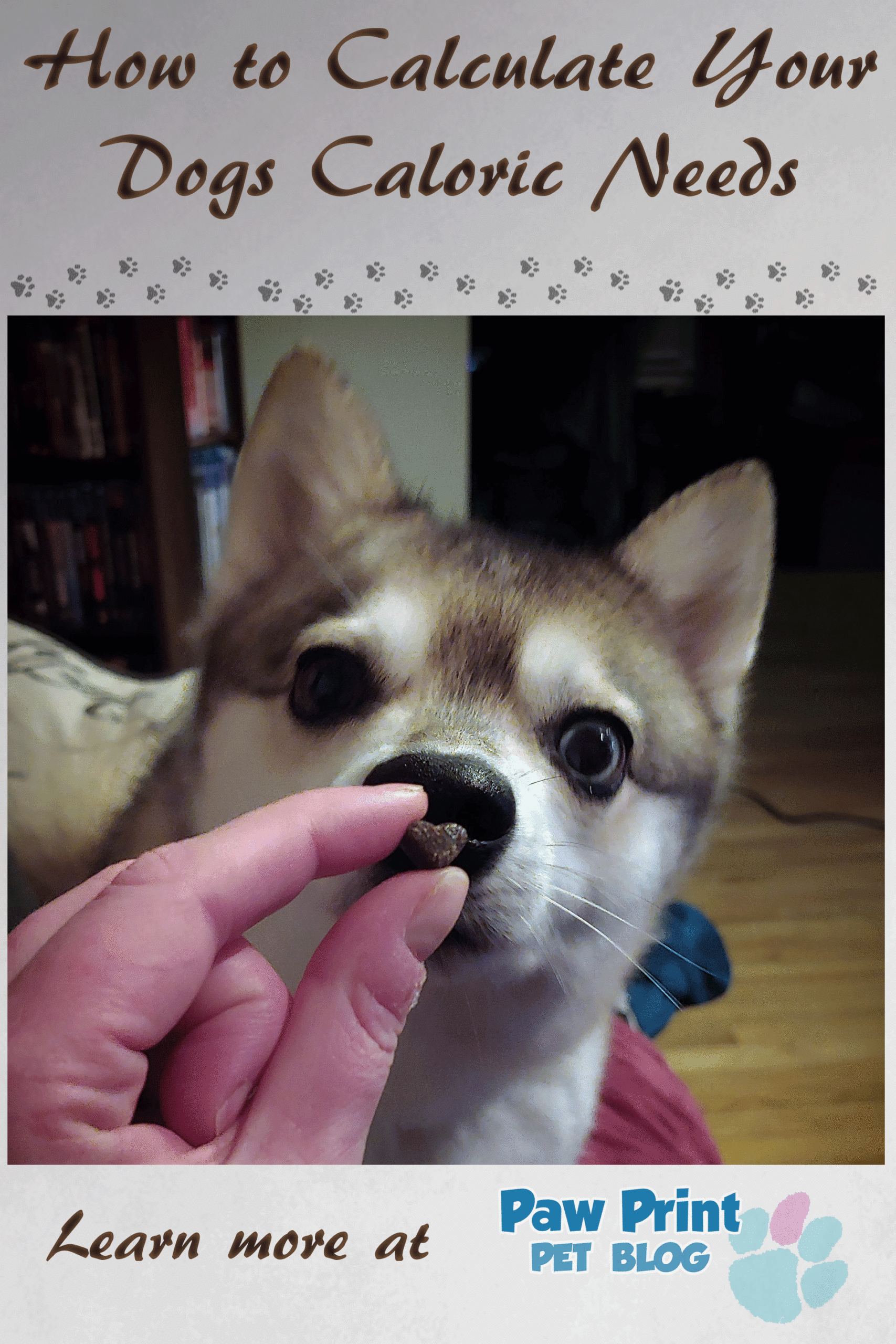
    How to Calculate Your Dogs Caloric Needs

    September 16, 2022

    Obesity is a growing epidemic for pets. Even some well meaning owners allow their pets to become overweight. It can be hard to refuse giving your pet extra treats.  With today’s hectic schedules it can sometimes be hard to give our pets the exercise they need.  If your dog is already overweight, or even if your pet is a healthy weight and you just want to make sure it stays that way, the first step in maintaining a healthy lifestyle for your furry friend is to find out how many calories a day your dog should be eating. It’s a step that’s often times overlooked, but healthy eating habits are key to maintaining a healthy weight.

    Post Contents:

    • 1 Meal Planning for Fido
    • 2 So how do you determine how many calories a day your dog needs?
    • 3 Only a Baseline
    • 4 How much you feed your pet should take into account many factors.

    Meal Planning for Fido

    dog caloriesKnowing how many calories your dog needs a day can help you plan their meals.  Did you know that many pet food companies overestimate the amount of food they tell you to give your pet each day? Pet food companies are, like any other company, out to make money. The more of their food your pet eats, the more often you will have to purchase their product.  The more money they make!

    If you know how many calories your pet should be getting each day, you can calculate the amount of food to feed them according to their individual needs. Also, knowing how much food your pet should get a day can help you to determine and offset how many treats your pet gets. You don’t have to stop giving your pets treats.  But if you give them a lot of treats one day you can make up for the extra calories in the treats by feeding less of your pets regular food.

    So how do you determine how many calories a day your dog needs?

    For a dog, the formula (Dogs body weight in kg X 30 + 70 = Daily calorie requirement) can be used to estimate your dogs resting energy requirement.  This is how many calories your dog would need to maintain their current weight while at rest.  1 kilogram is 2.2 pounds. So a dog that weighs 20 lbs weighs 9.07 kgs. If we plug 9.07 kgs into the formula, we get 342.1. So a dog weighting 20 pounds needs about 342.1 calories a day, while at rest, to maintain his or her current weight.  This is only a baseline, however, and does not take into account your dogs energy level.

    To attempt to take into account your dogs energy level, you can multiple the number you get with the formula above by another number, as follows:

    • X3 for a growing puppy up to 4 months old
    • X2 for a growing puppy over 4 months old
    • X1.6 for a fixed adult dog
    • X1.8 for an intact adult dog
    • X1.4 for an adult dog that is prone to obesity
    • X1.0 if your dog actively needs to loose weight
    • X2 for an adult working dog preforming light/moderate work
    • X4 to X8 for an adult working dog preforming heavy work

    So if we continue from the example above, lets say our 20 lb dog is a neutered adult.  We would take the 342.1 calories we got above and multiply that by 1.6.  That would give us 547.36 calories per day, taking into account the dogs energy level.

    dog caloriesIf you don’t want to do the math yourself, the Pet Nutrition Alliance has an online calorie calculator for adult dogs.  It was designed for vets, so you’ll want to enter your pet’s info under the tab that says “patient”.  Besides plugging in your dog’s weight and whether they are fixed, there is a slider you can use to indicate their current body condition.  When I used this calculator, plugging in the info for a 20 lbs, adult neutered dog, I got a number slightly lower than the number I calculated here.  The Pet Nutrition Alliance calculator estimated the same dog will need 514 calories per day.  The number being slightly different isn’t a huge deal, however, because these numbers are…
    Only a Baseline

    These calculators/formulas are a good place to start.  But it’s hard to take into account every factor that will impact your dog’s caloric needs in a calculator.  Dogs that are more active, young, pregnant or lactating, or kept in extreme temperatures will need more calories per day to maintain their weight.  Dogs that have slower metabolisms, or are very lazy will, in general, require less calories.

    Always keep an eye on your dog’s physical condition.  If he/she starts to gain weight, you can reduce the amount of food per day. If the opposite occurs and your dog starts to lose too much weight, increase the amount of food you feed daily.

    After you find out about how many calories your pet needs per day, you can calculate how much food to feed them based on the numbers on the back of your pets food bag. Pet foods should list calorie content in same way that human foods do.

    How much you feed your pet should take into account many factors.

    Keep a watchful eye on your pets waistline.  There are a lot of factors that can influence how much food our pets’ need to maintain their weight.  Calculating how many calories to feed them isn’t an exact science.  An observant owner should notice when/if Fido is starting to get a little too ‘fluffy’.  If you are unsure about what a healthy weight for your pet is, talk with your veterinarian.  Stay proactive about your pets weight to prevent him/her from becoming part of the pet obesity epidemic.

    dog calories

    Pet Tips

    Is it Safe to Burn Candles Around Dogs?

    September 15, 2022

    Fall is almost upon us.  The cooling weather always seems to put me in the mood to clean.  There’s nothing more comfortable than having a clean house, comfy pajamas, a dog (or two) to snuggle with, a good book, and a scented candle burning for good measure.  Why doesn’t love when their house smells nice?  Candles can help set the atmosphere in our homes, serve as decorations, and fill our spaces with their pleasant scents.  But have you ever stopped to think about whether candles are safe to burn around dogs?

    Post Contents:

    • 1 Keep Pets Away from Open Flame
    • 2 But Do Candles Present Dangers to Dogs Besides the Open Flame?
    • 3 Are Some Type of Candles Safe?
    • 4 Best Practices for Safely Burning Candles around Dogs
    • 5 Alternatives for Using Candles Around Pets
    • 6 I Don’t Miss Burning Candles!

    Keep Pets Away from Open Flame

    I know, I know, it’s kind of common sense.  But it’s worth writing anyways, if you’re going to burn candles around any type of pet, you need to keep them out of your animals’ reach.  Make sure to always keep candles somewhere where your dog can’t reach them, especially when they are lit!

    But Do Candles Present Dangers to Dogs Besides the Open Flame?

    candles dogsUnfortunately, besides exposing us to their pleasant odors, some candles release carcinogens and neurotoxins.  In addition, some contain animal by-products and other ingredients that are bad for the environment.


    Candle companies in the US aren’t required to list their product ingredients, so finding animal and environmentally friendly candle brands can sometimes be difficult. Ingredients such as Spermaceti and Stearic Acid are both animal derived ingredients sometimes used in candle making. Spermaceti is a waxy oil found in cavities in the heads of Sperm whales and dolphins. Stearic Acid is a fatty acid usually derived from beef, sheep, or pig fat.

    Paraffin based candles are the most common type sold today. Paraffin is a petroleum product, that when burned can release toxins into the air. Some of these toxins are known carcinogens and can be damaging to your health, your pets health, and to the environment.

    Many candles are scented with essential oils, not all of which are safe for dogs.  Many essential oils, such as cinnamon, pennyroyal, peppermint, pine, citrus (d-limonene), birch, tea tree, wintergreen, Ylang ylang, clove, garlic, anise, thyme, and juniper are not considered to be dog safe.

    Are Some Type of Candles Safe?

    That doesn’t mean that you necessarily have to stop burning candles if you enjoy having them in your home.  Candles made from beeswax or soy contain plant based ingredients and are much healthier for you. Make sure you double check with the candle company before making a purchase, as some candles labeled as being environmentally friendly may still contain small amounts of animal by-products. But vegan, environmentally friendlier candles do exist! They may cost a bit more than usual, but as the saying goes, you get what you pay for. You are paying extra for higher quality, healthier ingredients. An added benefit is that all natural candles often have a more pure, pleasant scent, and they usually last longer than paraffin based candles.

    Best Practices for Safely Burning Candles around Dogs

    Avoid overly strong scents, and candles that use essential oils that are toxic to dogs.  I personally will often look for all natural (ideally beeswax) candles scented with lavender.  Lavender oil is dog safe, smells great (at least I think so) and is known to be a relaxing scent for both humans and dogs.  Don’t burn candles in small, enclosed areas.  Make sure your dog can escape from the scent if he/she wants too.  Remember, even if a scent/candle is dog safe, your dog’s nose is way more sensitive than yours is!

    Never leave candles where your dog can get them.  Of course lit candles near pets presents a fire hazard, but unlit candles can be dangerous too.  Contact your veterinarian if your dog eats or chews on candle wax.

    Alternatives for Using Candles Around Pets

    If you love the looks of shining candles around your home, but are looking for an alternative to actual candles, led (battery powered) “candles” look nice and eliminate the dangers of open flame.  You’ll still want to keep them away from overly curious dogs (eating the batteries would be really dangerous), but you wouldn’t have to worry about them releasing any toxins.  I love the led candles, especially around the holidays, because I can leave them in places, such as the window sills, where I wouldn’t feel safe putting real candles.

    Of course led candles don’t make your house smell any nicer.  For that, you can consider upping your cleaning regime.  Open your windows, even for a short time on a cold day, can help the air in your home smell fresher.  Some essential oils are dog safe if you want to use an essential oil diffuser.  Air filters won’t add scent to the air, but can help eliminate bad odors.  Bags of charcoal placed in strategic areas can help to adsorb bad odors.  You can look for pet safe, scented cleaning products and sprays to use too.  Or, and any other people in your house will love this one, you can bake something to make your house smell amazing!

    I Don’t Miss Burning Candles!

    I used to burn candles a lot, especially in the fall and winter.  When I learned how bad they can be for us humans, my dogs, and the environments, I started getting a lot more picky about what types of candles I’ll buy.  Then, a few years ago now, I bought a bunch of led candles.  Ever since then I cut way back on how many actual candles I buy.  If you had asked me a few years ago if I’d miss burning candles I would have said yes!

    But I don’t, really.  The led candles look great, and are safer.  I don’t have to worry as much about where I put them, or forgetting to blow them out.  I’ll sometimes use an essential oil diffuser with dog safe essential oils when I really want my house to smell nice.  Otherwise, I just make sure to stay on top of my cleaning schedule to avoid bad odors.

    Comment below!  What are some dog friendly tips you have for keeping your house smelling fresh?

    candles dogs

    Pet Tips

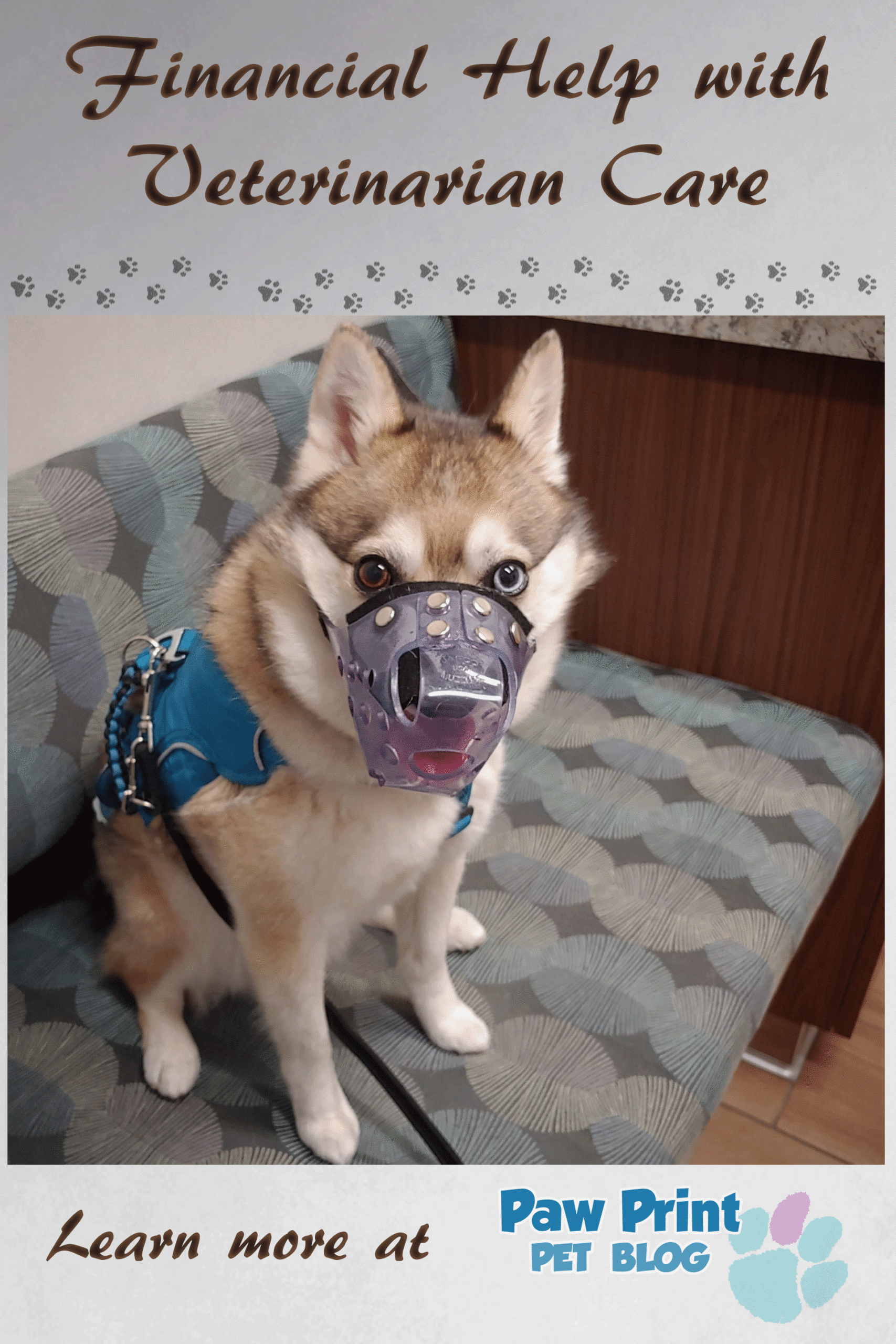
    Financial Help with Veterinarian Care

    September 14, 2022

    Visiting the vet is one of the many responsibilities that comes with owning a pet. It may not be fun, but it’s important for your pets health. Challenging economic times couple with the rising cost of quality vet care means that more people than ever are struggling to pay their pets’ expensive vet bills. Pet ownership isn’t something that should be entered into lightly, and you should always make sure you are financially able to care for an animal before bringing it into your home. However, even for the most prepared owners, sometimes things happen that are out of our control.

    Post Contents:

    • 1 Help Paying Non-Emergency Vet Bills
    • 2 Help Paying for More Pressing/Emergency Vet Bills
    • 3 Organizations that May Help
    • 4 Prepare for Future Vet Bills

    Help Paying Non-Emergency Vet Bills

    If you need help paying for non-emergency vet bills, you can consider having a yard sale, bake sale, or selling things online to help raise money. Let people know why you are trying to raise money. Some people may be more willing to buy from you if they know that their money will be going to help your pet.

    Try to keep a working relationship with your vet. If your veterinarian knows you well, and knows you are a caring owner, they may be more likely to work with you during a financial hardship.

    If they aren’t, call around and talk to other vets. Some of them may be willing to set up some kind of a payment plan, so you can pay your bill over time instead of all at once. Call your local shelters and ask if they know of any low cost vets. Some shelters have their own vet clinics and may be able to treat your pet at a lower cost, or set up a payment plan.

    If those options don’t work out, you can consider using credit to pay for vet bills. Either a regular credit card, or you can apply for care credit. Care credit works like a credit card, but can only be used at certain medical establishments (including some veterinary offices).  http://www.carecredit.com/

    Help Paying for More Pressing/Emergency Vet Bills

    help vet billsCheckups and shots are one thing.  Our pets’ yearly exams are important, but if you have to put them off for a bit while you save up funds it’s not the end of the world.  Health issues, some of which may be emergencies, are quite another issue.  There are situations when our animal friends need to receive medical treatment, and we don’t have the luxury of being able to wait.

    Credit cards, including Care Credit, are payment options you can utilize in emergency situations.  Some people have good luck raising money on sites such as GoFundMe.    Again, don’t be afraid to ask your vet about the possibility of a payment plan.  These days, not many of them seem super willing to set up payment plans, but it doesn’t hurt to ask.  You can see if your vet will accept Scratchpay, which is a 3rd party platform that allows you to set up payment plans.

    Organizations that May Help

    If you’re really in a bind, there are some organizations out there that may be able to help you.

    • The Pet Fund: The Pet Fund helps approved owners pay for non-basic, non-urgent care.  This includes things like pet cancer treatment, heart disease treatment, etc.
    • The Mosby Foundation: The Mosby Foundation helps owners in need pay for non-routine, non-emergency care.
    • Dylan’s Hearts: This organization can work with pet owners in North Carolina, South Carolina, Virginia, Tennessee, and Georgia, who have a pet with a life threatening injury or illness.
    • Frankie’s Friends: Frankie’s Friends helps owners in need with grants to help pay for lifesaving veterinary care.  They have specific programs for pets with cancer and eye issue.
    • Friends & Vets Helping Pets: This organization works with participating veterinarians to help owner’s in need pay vet expenses.
    • Paws 4 a Cure: Paws 4 a Cure is a volunteer run organization that helps owners pay for non-routine veterinary care.
    • Red Rover: Red Rover offers small urgent care grants for pet owners in need.
    • The Onyx & Breezy Foundation: This foundation offers grants for animals in need of medical care, including medication, spay & neuter, etc.
    • Violet’s Friends in Need Fund: This fund provides financial assistance for urgent veterinary care.
    • Magic Bullet Fund: This organization specializes in helping pets in need who have cancer.
    • Live Like Roo: The Roo fund also provides financial help for owners who have pets fighting cancer.
    • Fetch A Cure: Works with owners in Virginia, DC, or Maryland who have a pet with cancer.
    • The Riedel & Cody Fund: Assistance for owners whose pets are fighting cancer.
    • The Zeus Oncology Fund: Provides financial assistance for dogs’ cancer treatments.
    • Frosted Faces Foundation: This foundation helps owners in California in need who have senior dogs.
    • Deaf Dog Education Action Fund: This fund helps newly placed deaf dogs with who incur extraordinary medical expenses.
    • Poodle Angles: Provides help with vet bills for poodle owners.
    • The Brown Dog Foundation: Provides help paying for vet bills.

    Did we miss anyone?  Are any of these organizations no longer around?  Let us know in the comments below!

    Prepare for Future Vet Bills

    If you’re reading this and not currently experiencing a pet medical emergency, remember that it’s never too late to start a vet fund!  Even if you can only put away a little bit of money each month, every little bit can help!  If you’re dog doesn’t already have a lot of preexisting conditions, it might be worthwhile to consider pet insurance as well.

    Comment below!  Have you ever tried using any of the organizations listed above?  What are some things you do to financially prepare for vet bills?

    Original article posted 11/1/2010, last updated 9/14/2022.

    help vet bills

Older Posts
Newer Posts
It's a beautiful day to play ball in the snow ❄️ It's a beautiful day to play ball in the snow ❄️
Today would have been Kit's 17th birthday. My best Today would have been Kit's 17th birthday. My best buddy...not a single day goes by that I don't think of him. Forever a beloved member of our little pack ❤️
Someone stole his dad's socks 😂 10 years old and s Someone stole his dad's socks 😂 10 years old and still as mischievous as a pup!  This little one makes me laugh everyday and I'm SO thankful for him. 💙
New phone, who dis!? 😅 Sorry for the lack of new New phone, who dis!? 😅 
Sorry for the lack of new Fen pics lately... My old phone broke and it took me awhile to replace it. 
Fen is his happy, sassy, playful self and is doing well. 💙
Fen makes me laugh so much! Today is my partner's Fen makes me laugh so much! Today is my partner's birthday. ❤️ I almost always wake up earlier than him, so this morning I was planning on getting up to decorate for his birthday. I wanted to surprise him with decorations and his presents set out when he got up.

Well...Fenrir ruined it all, because as soon as he saw the wrapped presents for my partner, he got SO excited! And if you have ever had the pleasure of meeting an Alaskan Klee Kai you will know, when they get excited, they just have to make sure everyone knows about it!

Long story slightly shorter, Fen woke my partner up early, on his birthday, all because Fen REALLY wanted to open presents that weren't even for him! I didn't get to decorate, but lesson learned - don't put gifts where Fen can see them because he will get really, really excited about it.

And just so you all don't feel too bad for him...I ended up wrapping one of Fen's Christmas presents and giving it to him to open early! 🤣
Follow on Instagram
Facebook Instagram Pinterest Youtube

Copyright © 2025 Paw Print Pet Blog. All Rights Reserved.

Back to top