• Home
  • Popular Topics
    • Papillons
    • Alaskan Klee Kai
    • Hiking with Dogs
    • Dog DIY
    • Recipes
    • Dog Product Reviews
    • Can Dogs Eat…
    • Dog Health
  • The Paw Pack
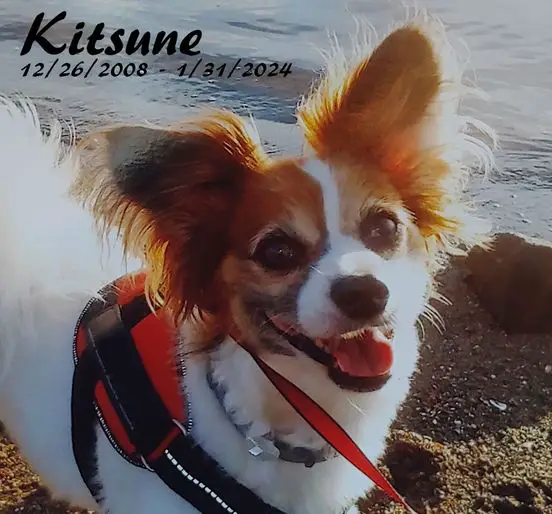
    • Kitsune (2008 – 2024)
    • Fenrir
  • Policies
    • Disclaimer
    • Privacy Policy
    • Work with Us
    • Site Map
  • Contact

Paw Print

    All About Dogs, Senior Dogs

    What Is Anticipatory Grief And What Does It Have To Do With Dogs?

    May 16, 2024

    I once read a quote about dogs that I don’t feel like trying to find right now.  If I do end up finding it I’ll update this later.  It was about how dog lovers must sign an invisible contract when they bring a new dog into their lives.  You get insane amounts of unconditional love, snuggles, tail wags, laughter, happy days, and fun.  But the price you eventually have to pay for all that is steep.  I don’t have to type it.  We all know what the price we pay is.  I know all too well what the price we pay is, because I’ve recently paid it.  I’ve been paying it.  I think I paid in extra, because I started making deposits before my balance was due.  Who do I talk to about a refund?  I jest, of course.  This post is about anticipatory grief.  What is it?  And what the heck does it have to do with dogs?
    happy senior dog

    Post Contents:

    • 1 Anticipatory Grief
    • 2 Symptoms of Anticipatory Grief
    • 3 Wait, So Is Anticipatory Grief A Good Thing, Or Bad?
    • 4 How to Cope With Anticipatory Grief
    • 5 What Does Any Of This Have To Do With Dogs?
    • 6 Anticipatory Grief Is A Double Edged Sword
    • 7 A Quick Update…
    • 8 Comment Below!

    Anticipatory Grief

    Probably somewhat obvious by the name, anticipatory grief, sometimes also referred to as preparatory grief, is a type of grief that is felt before a loss.  Anticipating an impending loss can trigger strong emotions such as sadness, fear, anger, isolation, anxiety, or guilt.  Anticipatory grief is often associated with an impending death, such as in situations where you are aware that yourself, or a loved one, is nearing the end of life.  It can occur in other situations too, however.  Some more common examples included feeling anticipatory grief over the impending loss of a relationship, such as a breakup or divorce, or a major life event such as a move or job change.  “Regular” grief typically occurs after experiencing a loss.  Anticipatory grief is grieving for a loss that has not yet occurred.

    Symptoms of Anticipatory Grief

    Common symptoms of anticipatory grief can include the following…

    • Anger
    • Irritability
    • Numbness and disbelief
    • Guilt
    • Sadness
    • Anxiety
    • Fear
    • Mood swings
    • Loss of control over emotions
    • Desperation
    • Dread
    • Lack of motivation
    • Loneliness
    • Isolation
    • Depression
    • A preoccupation with the terminal loved one

    Sounds fun right (/sarcasm)?  Although it’s thought that anticipatory grief can actually help some people mentally prepare for an impending loss, it’s not a pleasant experience to go through.  The symptoms of anticipatory grief can be bad enough that they negatively impact a person’s everyday life.

    Wait, So Is Anticipatory Grief A Good Thing, Or Bad?

    Studies on anticipatory grief have been pretty inconclusive.  For some people, it does seem to come with some benefits.  Anticipating a major loss before it occurs can help some people to prepare for what is to come.  It can give them time to come to terms with the loss before it happens, which can sometimes make it easier to do things such as say their goodbyes to loved ones, or make necessary preparations ahead of time.  For some people, anticipatory grief can make dealing with a loss easier because they’ve had time to process things ahead of time.

    For other people, anticipatory grief can be, at best, just the beginning of their grieving process.  It doesn’t always adequately help people to prepare for experiencing a loss.  At worst, for others, it can be the beginning stage of prolonged grief disorder.  Between 7% and 10% of adults experience prolonged grief disorder, according to the American Psychiatric Association, which can cause intense, persistent, long term symptoms of grief.

    How to Cope With Anticipatory Grief

    Anticipatory grief can be especially hard.  Oftentimes anticipatory grief ends because the normal grieving process has began.  Many people will experience at least some symptoms of anticipatory grief up until the event they are preparatorily grieving for occurs.

    Talking to understanding loved ones, friends, or even a therapist may help if you are experiencing anticipatory grief.  If you are experiencing extreme symptoms, or symptoms that impact your physical health such as sleeplessness or lack of appetite you should talk to your doctor.  Practicing mindfulness and self care can sometimes help ease symptoms.  Try to maintain a healthy diet and sleep schedule, and exercise regularly if you can.  Meditation or other relaxation exercises may help ease stress.  Find what works for you!  Everyone experiences grief in their own way, and what helps them to get through that grief may differ as well.

    What Does Any Of This Have To Do With Dogs?
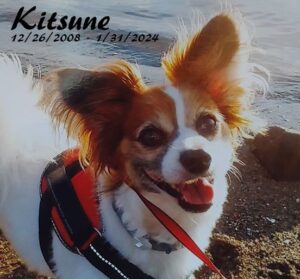
    Rest in peace, KitsuneThis is a dog blog after all.  In January of this year (2024) I lost my first dog, my amazing best buddy Kitsune.  After 15 years together, as you can probably imagine, dealing with his death has been hard.  Kit was a live life loud kind of dog, and pretty much up until the day that he died he was making trouble.  Trouble was (literally) his middle name and he 100% lived up to it!  He had cancer, but it, unfortunately, took us a long time to figure out he had cancer.  Who ever suspects that a dog who is barking at you for second dinner and racing around the house not only has cancer, but has advanced, terminal cancer?  I certainly didn’t.  Our vet didn’t either.

    Despite not knowing about Kit’s cancer at the time, I experienced a lot of anticipatory grief especially throughout the last year or so of his life.  I knew that Kit was getting old, and we started having to deal with more health issues with him.  He was diagnosed with IVDD in 2022 so I worried a lot about him experiencing a flare up of that.  He also had arthritis and a heart murmur that we had to stay on top of monitoring.

    Let’s face it, health issues aside every senior dog owner knows they have a very sad day ahead of them.  It’s the price we pay for all the amazing years of love and companionship our dogs give us.  Caring for a beloved aging, senior dog can be a mentally exhausting experience.  For me, I for sure had the symptom of “preoccupation with the terminal loved one” when it came to my anticipatory grief over Kitsune.  I spent a lot of time worrying about Kit and trying to think of new ways to make his life even better.  I’ll never regret doing everything I could to make every moment of his life as happy and as comfortable as possible, but I will admit that the amount of time I was spending worrying about him was causing me a lot of stress.  I would cry sometimes thinking about losing him, which then made me feel frustrated.  I didn’t want to spend whatever amount of time I did have left with him grieving him prematurely.
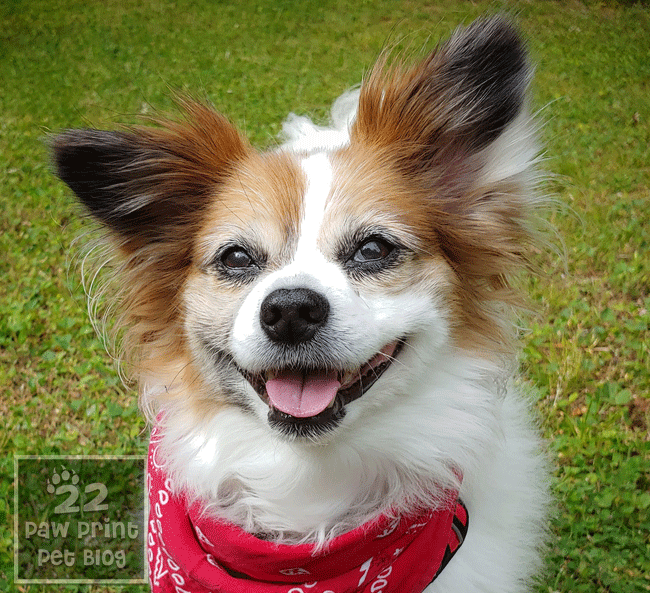
    papillons cuddly

    Anticipatory Grief Is A Double Edged Sword

    Was the anticipatory grief I experienced before losing my senior dog a good thing or a bad thing?  I will say that it made me really focus a lot of attention on Kit.  Because I was somewhat preoccupied with thinking about his death, I was hyper aware of how important it was to really appreciate the time I had with him.  That last year or so of snuggles were extra sweet.  I admit that I got quite lax when it came to any form of discipline, because how can you say no to a senior dog?  Kit got all the snuggles, and walks, and (almost) all the treats that he wanted.  He’d always been spoiled, but especially so in his last years of life.  No regrets there.

    papillonI feel like really appreciating the time I spent with Kit, and spoiling him so much, in a small way did help me deal with his death.  I knew when he died that we had given him a good life.  That I didn’t take him for granted and that, other than not finding out about his cancer sooner, I didn’t have any major regrets when it came to how I cared for Kit, especially in his senior years.

    But, at the same time, the anticipatory grief was hard.  It was stressful and sad.  In some ways, I feel like it may have been even harder than the actual grief I started dealing with after Kit died.  The actual grief has been really hard, don’t get me wrong, but, for me at least, it’s not as anxiety inducing.  It’s weird to feel like I’ve been grieving for a dog for so long, when he only died 3ish months ago.

    I still have my Alaskan Klee Kai, Fenrir, and I know I’ll more than likely have other dogs in my life in the future.  I hope I don’t experience anticipatory grief with Fenrir or any of my future dogs as strongly as I did with Kitsune.  I’m confident that I can appreciate them in their senior years, the way I did with Kitsune, without the added stress of prematurely grieving them at the same time.  Kit taught me so many important life lessons, one of them, sadly, being about all the hard aspects of living with, and losing, a senior dog.  I’m hoping those lessons will make my next loss a bit easier to deal with, but I guess only time will tell.  And hopefully it will be a very long time before I lose anyone else close to me!

    A Quick Update…
    pet bloggers journey 2024In my last post I said I was going to try to stick to an every other week posting schedule here.  Clearly that hasn’t been working out.  I have to admit, that since losing Kit posting here has just been difficult.  I’ve had some major writer’s block when it comes to writing about dogs, and writing about Kit still makes me cry.  It’s still my plan to post here at least every other week eventually, but for now I’m just going to do what I can.  For anyone who wants to hear from us more often, I’ve been more active on our Instagram and Facebook pages than I have here.

    We are doing ok!  My partner, Fenrir, and I are all really missing Kit.  It just sucks so much not having him around.  It feels like a big part of our little family is missing – because it is.  I still have bad days, and sometimes bad weeks.  But we’re ok.  The weather here is finally warming up so we’ve been trying to spend a lot of time taking advantage of that.  Nature therapy for the win!  Everyday after work I spend time playing outside with Fenrir, and we’ve been fitting in as many spring hikes as we can find time for.

    “Healing in grief is a lot like the onset of spring. It’s unreliable and fickle. One day it’s warmish and blue skies and we think, “Hey! We’re feeling better!” Then the next day -or week- it’s sleeting and gray again. But ever so slowly, we advance into better weather. We can’t rush it. We can’t control it. We can’t skip the dismal days. But we can trust that spring and then summer will come.”
    – Dr.Alan Wolfelt

    Comment Below!

    Have you ever experienced anticipatory grief?  Did you find any techniques that really helped you to deal with it?
    What Is Anticipatory Grief And What Does It Have To Do With Dogs? Pinterest

    We’ve, unfortunately, been dealing with content scrapers stealing our articles. You shouldn’t be seeing this article on any site other than pawprintpetblog.com! If you’re reading this article on any other site, we’d love for you to take the time to contact us and let us know and, if you have the time, stop by and visit us on our official site! Thanks you.
    Pet Tips

    Helping Your Dog Cope With Losing A Friend

    March 14, 2024

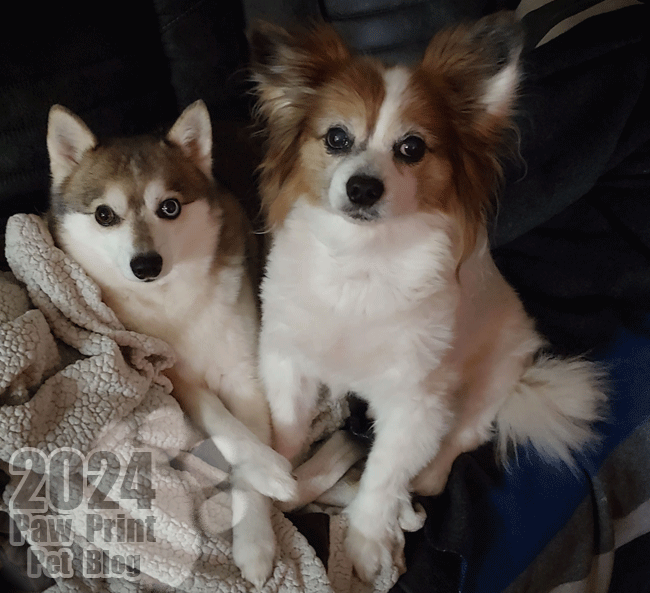
    A few weeks ago I was finally able to post about losing my first dog, Kitsune.  Our beloved Kitsune passed away peacefully on January 31st.  We had just celebrated his 15th birthday a little over a month earlier.  As any dog lover can imagine, the loss of such a special member of our pack has really hit hard.  We got our second dog, Fenrir, when Kitsune was 8 years old.  Fen was raised with Kitsune!  From the day we brought Fen home, when he was 9 weeks old, until Kitsune passed away, there wasn’t a single day of Fen’s life that he didn’t have his big brother by his side.

    Kitsune & Fenrir

    I knew that staggering my dogs’ ages by so many years would most likely mean that I’d eventually have to deal with losing one well before the other.  Having Fenrir here to cheer me up has been such as blessing as I navigate losing Kitsune.  But I, sadly, have to admit that the past month and a half or so has also been hard on little Fen.

    Post Contents:

    • 1 How My Dog Reacted To Losing His Best Buddy
    • 2 Some Signs That Your Dog Is Grieving
    • 3 Tips For Helping Your Dog Deal with Grief
    • 4 Don’t Change Other Aspects Of Your Dog’s Life Too Quicky.
    • 5 But Make Changes As Needed.
    • 6 Try Not To Act Overly Emotional Around Your Dog.
    • 7 Manage Your Own Grief.
    • 8 Make Sure You Are Attending To Your Dog’s Needs.
    • 9 Spend Time With Your Dog.
    • 10 Engage Your Dog’s Body.
    • 11 Engage Your Dog’s Mind.
    • 12 Enlist Your Vet If Needed.
    • 13 Give Your Dog Time.
    • 14 Should You Get Another Dog?
    • 15 My Plan With Fenrir

    How My Dog Reacted To Losing His Best Buddy

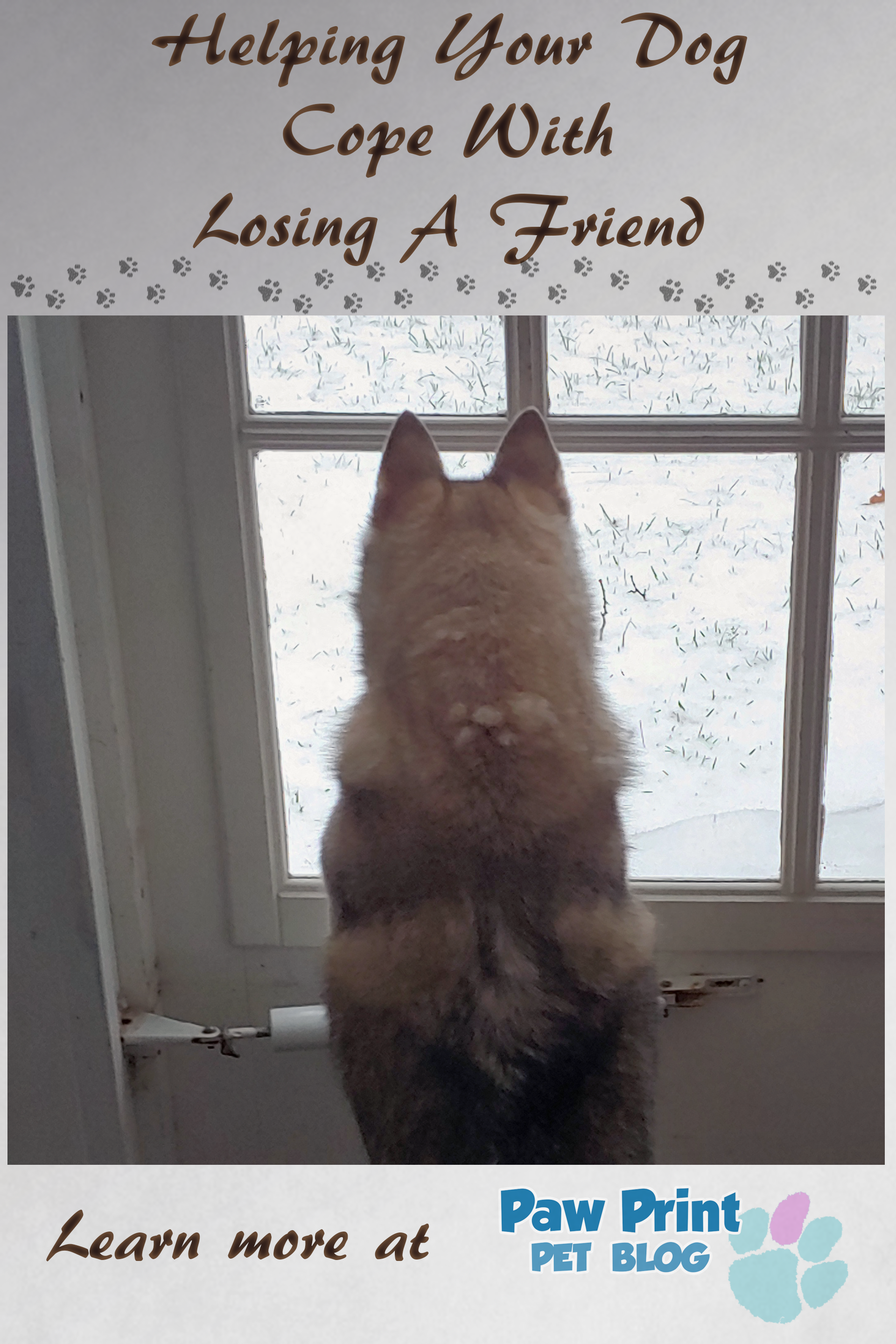
    pet parentsThe first couple of days without Kitsune were especially hard.  Fen whined a lot, and spent time running around the house trying to find Kit.  Our biggest problem, by far, in dealing with Fenrir after the loss of Kitsune has been getting Fen to eat consistently.

    Fen has always been a very picky eater.  It’s a relatively common Alaskan Klee Kai trait.  As picky as Fen’s always been, he got about 3,000 times worse after we lost Kit.  I think the problem has been twofold.  Fen has always been a sensitive dog.  He gets upset easily, and when he’s upset he doesn’t eat.  In addition to that, I’ve come to realize that I relied a lot on Kitsune to help me encourage Fen to eat regularly.  Kit loved food.  Fen grew up knowing that if he didn’t eat his food when it was offered Kitsune would happily eat it for him!  Plus, Kit’s love of food was contagious.  Fen, not wanting to be left out of the excitement of meal time, would often eat something if he saw Kitsune eating it first.

    Since having Fen as an only dog, meal times have been a huge struggle.  Not only can I often times not get him to eat dog food, but he won’t take table scraps or treats either.  Before anyone asks, yes Fenrir has seen a vet and gotten a clean bill of health.  His lack of appetite is, thankfully, not being caused by a physical health issue.

    Some Signs That Your Dog Is Grieving

    • Loss of appetite
    • Increased episodes/symptoms of separation anxiety
    • Increased clinginess to human or animal family members
    • New behavioral issues such as accidents in the house, increased vocalizations, destructive behavior, etc.
    • Lethargy and depression
    • Personality changes
    • Sleeping more than normal or
    • Not being able to sleep
    • Pacing, or continuous searching for their missing friend

    If your dog displays these signs, or others, after the loss of a friend there’s a good chance that the symptoms are being caused be grief.  However, please always take your dog to the vet for a full exam if he/she displays new or worsening mental and/or physical symptoms.

    Alaskan Klee Kai

    Tips For Helping Your Dog Deal with Grief

    Don’t Change Other Aspects Of Your Dog’s Life Too Quicky.

    Changing aspects of your dog’s life, such as their schedule or environment, too quickly after the loss of a friend can be stressful.  Everyone grieves differently.  I know some people are eager to put away their deceased dog’s belongings.  But it may be beneficial to leave items, such as bedding and toys, in place as these types of items can bring comfort to your remaining dog.  Try to keep your remaining dog(s) schedule as consistent as possible.  If you are ultimately going to make changes to his/her schedule try to do so slowly.

    But Make Changes As Needed.

    That being said, if changing some aspect of your dog’s life will help them better cope then don’t be afraid to make changes.  With Fenrir, for example, I’ve decided to change his diet.  Feeding him the same food that I fed him and Kitsune just wasn’t working.  In our case, changing Fen’s food has been a better decision than continuing to attempt to offer him a food that he just wasn’t interested in eating anymore.

    Try Not To Act Overly Emotional Around Your Dog.

    This one is hard.  Our pets can be an amazing source of comfort when we’re dealing with sadness.  But dogs pick up on our emotions, and when they are already feeling the stress of losing a housemate, seeing their favorite people morn can add to their distress.  On days when I’m feeling particularly sad, I try to step away from Fen for a while.  I take the time I need to express my sadness away from my dog.  I’d never want to cause him excess stress because I’m having a bad day.

    Manage Your Own Grief.

    Because our dogs are so amazing at picking up on our emotions, finding ways to help yourself cope with your shared grief can go a long way towards helping your dog.  Help yourself so that you can better help those around you, your remaining dog included.  Remember that you can’t pour from an empty cup.

    Make Sure You Are Attending To Your Dog’s Needs.

    This tip may sound stupid but it can be easy to forget to complete basic tasks when you’re dealing with a really stressful situation.  I know when I was dealing with Kitsune being sick, and the direct aftermath, it was hard to complete everyday tasks such as walking Fen.  Even on your worst days, make sure you are attending to your remaining dog’s basic needs.  Forgetting to feed or walk Fido is going to increase his stress levels.

    Spend Time With Your Dog.

    Go for a walk, play in the yard, or just snuggle up in front of the TV.  After your dog loses a friend, he may feel lonely.  Spending time with your dog can help him feel more secure.

    Engage Your Dog’s Body.

    Exercise can be healing, especially for dogs.  If the weather is bad and you can’t walk your dog, or otherwise exercise them outside, take a look at our previous post about exercising your dog indoors.

    Engage Your Dog’s Mind.

    Physical exercise is awesome, but don’t forget that mental stimulation is important too!  Keeping your dog’s mind busy can help them focus on positive things other than their grief.  Consider engaging your dog’s mind by brushing up on their training, having them play with interactive toys such as puzzles, or letting them explore new areas.

    Enlist Your Vet If Needed.

    If your dog is showing extreme symptoms of grief, or doesn’t seem to be making improvements over time, don’t be afraid to enlist the help of your veterinarian.  Your pet may require more intense behavioral intervention or, in some cases, medication to help them get through an especially difficult time.

    Give Your Dog Time.

    But for the most part, like with people, your dog is going to require time to deal with their grief.  Be patient with your pooch as he/she adjusts to a new normal.  Change is hard, especially when chance means moving forward without a beloved pack member.  Try to be understanding of what your dog is going through.  They are not trying to give you a hard time when they act out, they are having a hard time.  Dogs are social animals that form strong bonds with family members.  Losing a pack member isn’t easy.  Be patient and give them the time they need to adjust.

    Should You Get Another Dog?

    Blogging from A to ZThis is a question that seems to come up a lot when a dog passes from a multi-dog household.  The answer, frustratingly enough, is that it depends.  It depends on you, your remaining dog, your unique situation.  There’s a lot to take into account before thinking about bringing a new dog home.

    Remember that a new dog will never replace the dog that was lost.  Adding a new dog to the mix won’t necessarily ease the grief that your current dog is experiencing.  A new friend may bring a lot of joy, but (puppies especially) can also bring a lot of frustration.  If your current dog is feeling down, he may not be in the right frame of mind to deal with an exuberant new pack member.  You know your dog(s) best.  Sometimes adding a new member to the pack cheers everyone up and helps hearts to heal.  Other times it’s too much too soon.  It can be a good idea to allow your current dog, and yourself, time to fully process grief before thinking about any new additions.

    My Plan With Fenrir

    I’ve been utilizing these tips for Fen and I think he’s doing ok.  Lately he’s been showing more excitement about going for walks and play, and he has stopped wandering the house searching for Kit.  Our biggest remaining issue is that Fen still hasn’t been eating consistently and I can tell, at times, that he’s still feeling down.  I’m going to continue spending a lot of time with Fen, and I’ve decided to try a new food with him.  I’m hoping if I find something he likes the taste of a bit more it will help encourage him to eat.  The food he was on worked well when we had another dog around to help encourage Fen to eat.  Now that Fen is an only dog, it’s just not cutting it anymore.

    I’ll keep you all up to date on Fenrir’s progress.  For more current updates consider following us on Facebook and/or Instagram.

    Comment below!  Did I miss anything?  If you’ve, sadly, had to help your dog going through a loss what are some things you did that helped him/her feel better?

    Posting regularly here has been hard for me since we lost Kit.  I know topics like these are important, but writing about loss, and just dogs in general, when we’re still dealing with a lot of grief isn’t easy.  I want to get back to posting here more often, but decided that going back to my every week schedule is too much for now.  Going forward, at least for now, I decided that I’m going to try to stick to a every other Thursday posting schedule.    

    Coping with losing a dog

    We’ve, unfortunately, been dealing with content scrapers stealing our articles. You shouldn’t be seeing this article on any site other than pawprintpetblog.com! If you’re reading this article on any other site, we’d love for you to take the time to contact us and let us know and, if you have the time, stop by and visit us on our official site! Thanks you.
    Kitsune, The Paw Pack

    Saying “See You Later” to Kitsune

    February 29, 2024

    This is a post I never wanted to have to write.  You’ll all have to bear with me because this will be a hard one.  Every word of this post will be typed through tears.  I’ve been trying to write this for weeks now and keep ending up having to stop working on it.  I don’t want to do this.  I don’t know how to do this.  But I have to try.  I, ultimately, want to continue blogging here and it just doesn’t feel right to go back to posting regular articles without posting this one first.

    On the afternoon of January 31st, 2024, we had to say a very tear-filled “see you later” to our beloved Kitsune.

    My sweet, silly Kitsune – my forever puppy, the snuggle king, my best buddy, and the original muse behind this blog.  Nothing I could write here will ever come close to doing Kitsune, and the amazing life my partner and I shared with him, any justice.  Kit was an amazing friend, who brought so much light and happiness into my life.

    I just don’t have it in me to go over, in depth, what happened.  But I know a lot of you will want to know.  Maybe I’ll be able to write more about what happened another time but for now I’ll just keep it simple.  Kit went from his normal, happy, sassy, demanding self to not feeling well in the matter of a couple of hours.  After a harrowing couple of days in the emergency vet, on medications that thankfully kept him comfortable, we learned, too late, that Kit had kidney cancer.  One of the tumors had ruptured and he was bleeding internally.  Everything went downhill from there.  Both of his kidneys were failing.  His blood stopped clotting normally.  We ran out of treatment options.  Except for one.  The one that meant that my Kitsune would be able to pass peacefully in my arms, instead of meeting a much worse fate.  The one that my brain knows was the right choice, but my heart aches so much over.

    dog's 15th birthday!Kitsune was the first dog that my partner and I ever raised on our own.  For 15 years there was barely a single day that I didn’t spend with Kit.  The silence after his loss is so loud.  He’s been physically gone from our lives for a month now, but I still get up to check on him, without thinking, while I’m working.  I still wake up at night thinking I can feel him snuggled up against my legs, the spot he kept warm every night for over a decade.  His toys and dog beds still litter the floor of our house.  His bowl is still sitting in the kitchen, his leash and harness hanging by the door.  I want my dog back.  I want to rub his belly and scratch behind his giant ears, his favorites.  To see his big, goofy smile and laugh about the way he would always raise his head up as high as he could outside, so he could better feel the wind.  To fall asleep on the couch with him snuggled up next to me, while my partner plays video games.  Life will never be the same without Kitsune.


    Kit came into my life in a time when I really needed a friend.  I was young and dumb and riddled with anxiety, newly living in a city I didn’t like almost 200 miles away from the life I had known.  It was my partner, Kitsune, and I against the world!  My partner worked really long hours in NYC which meant I would have spent most of my time alone, except I had Kitsune.  Because of him we spent our days adventuring, visiting parks, and beaches, and events around the city, making lots of friends along the way.  So many of the amazing people I still call friends today I met because of Kitsune.  I started this blog because of Kitsune!

    And now here I am, I guess having to learn to navigate life without Kit.  My heart is broken, but at the same time so, so full of love.  I feel so blessed to have been able to walk my path for 15 years with such a special friend by my side.  Kit was an amazing teacher and I will carry the life lessons he taught me, as well as a countless collection of happy memories, with me for the rest of my life.  Although he’s physically gone now, Kit will forever be a beloved member of our pack.  His memory will reside within my heart for as long as it’s still beating.  I’ll do my best to honor Kit’s memory as best I can, because he more than deserves it.  Part of that will mean that yes, I will still be blogging here, although it’s been hard to feel like I have the motivation to lately.  I think Kit would want me to continue trying to help other dogs, to continue sharing the amazing relationship that is the human-canine bond, even when it causes heartbreak.

    Thank you to everyone who has followed Kitsune’s journey.  For over 13 of his 15 years I’ve shared Kit’s life with all of you.  I’m sure many of you love him too, and will be upset by this news.  I’m sorry.  The worst part of loving dogs, by far, is this.

    Thank you, Kit, for everything.  You’re the best dog ever.  I’m so, so proud of you.  I love you.  This is not goodbye, never goodbye.  I’ll see you later…

    select veterinarian

    Kitsune, Senior Dogs, The Paw Pack

    Happy 15th Birthday, Kitsune!

    January 11, 2024

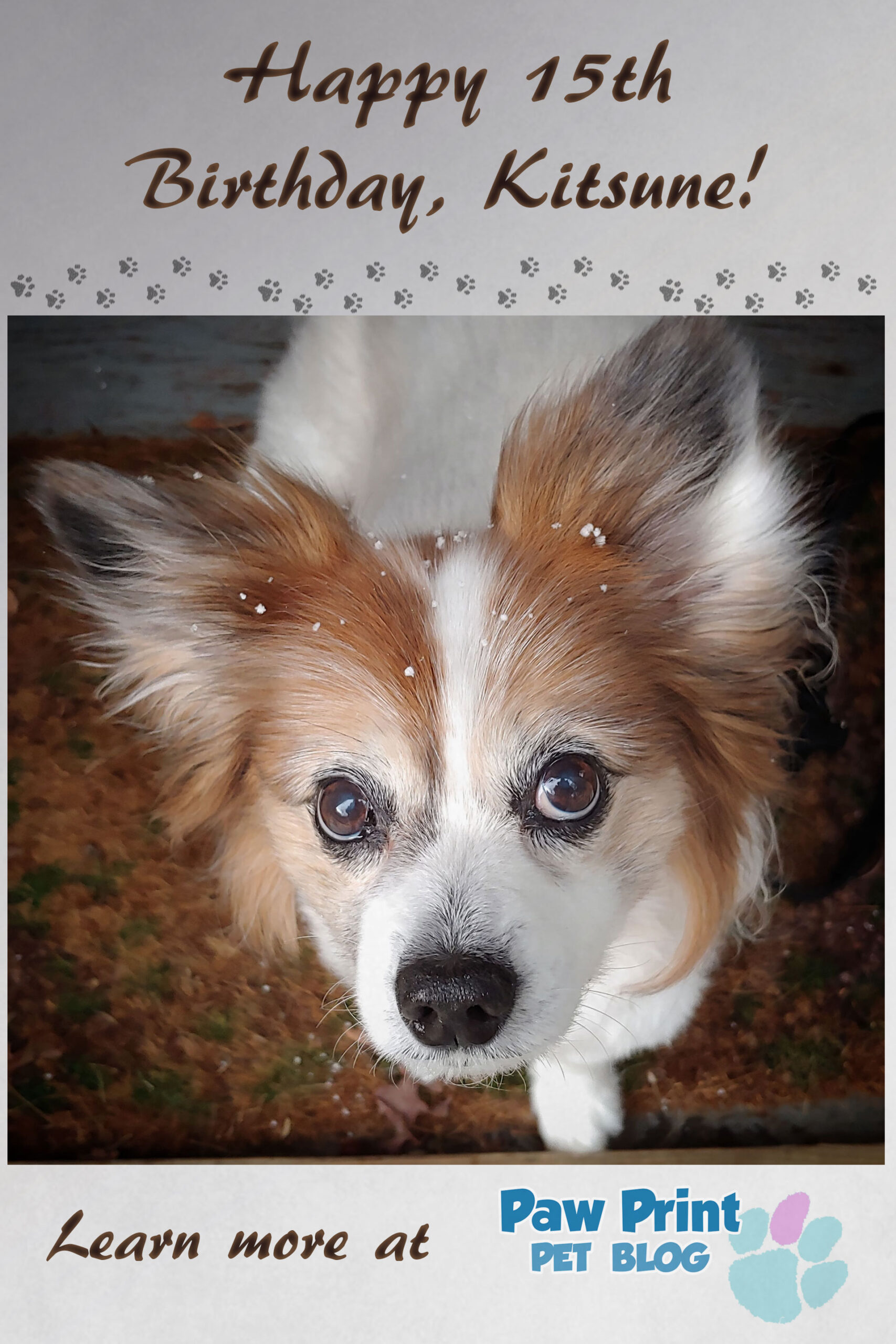
    On December 26th, 2023, the amazing Mr.Kitsune, my “forever puppy”, turned 15 years old!

    I’ve rewritten this post three times now because I keep not liking how it turns out.  Birthdays should be happy celebrations of life, but marking Kitsune’s 15th has been bittersweet for me.  I feel like the “every year is equal to 7 dog years” thing isn’t exactly accurate, but going by that Kitsune would be equivalent to a 105-year-old human!  That’s crazy!  I still remember the day we brought him home, as a tiny little 9-week-old puppy, like it was yesterday.

    Post Contents:

    • 1 A Bittersweet Birthday
    • 2 Kitsune is Feeling Much Better!
    • 3 A Happy Birthday
    • 4 Birthday Wishes
    • 5 Adventures Ahead!
    • 6 So Here’s to Kitsune!

    A Bittersweet Birthday

    dog's 15th birthday!As I mentioned in our Pet Blogger’s Journey 2024 post last week, Kit was sick around the holidays (including his birthday) this year.  Starting around the beginning of November, all at once we started having to deal with a couple of health concerns with Kitsune.  It was super frustrating because we had to wait for specialist appointments and test results to get a better idea of what we were/are dealing with.

    That meant we were going through a bit of trial and error on how to treat Kit and keep him comfortable until we could figure out what the best course of action would be.  There were a lot of unknowns for a couple of weeks.  Kit wasn’t feeling 100%, and when things we were trying to do to help him weren’t working it was stressful.

    I’m intentionally being vague.  I’m planning on writing separate posts about each of the health issues we had to deal with.  It would just be too much to write about all of them here, and I don’t want Kit’s birthday post to just be about him being sick!  The good news?

    Kitsune is Feeling Much Better!

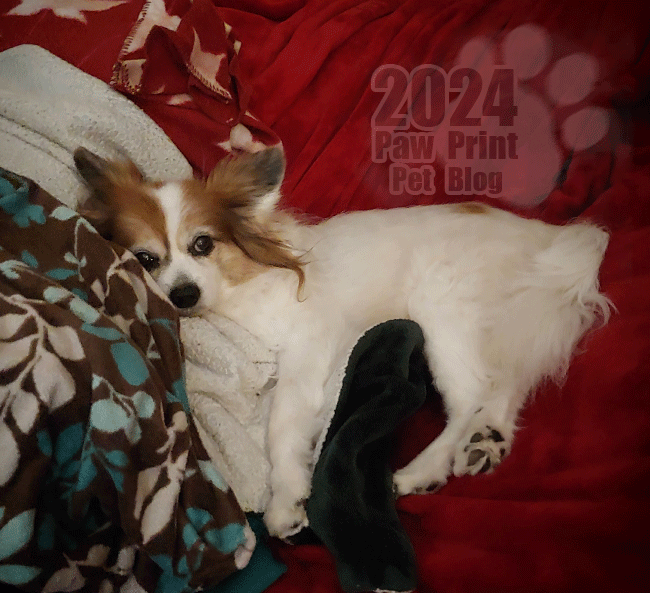
    dog's 15th birthday!As of the time of writing this post, Kit has gone an entire week without throwing up a single time!  That may not sound like a big deal, but believe me it is!  We’re pretty sure we finally have a correct diagnosis for one of the main issues he’s been dealing with and have (thankfully!) found a treatment that seems to be helping him feel better.  Especially within the last week, my sweet senior boy has been getting a lot of his energy back.  He’s even felt well enough to run zoomies around the house and has gotten back to one of his favorite pastimes – trying to body slam his “little brother”, Fenrir.
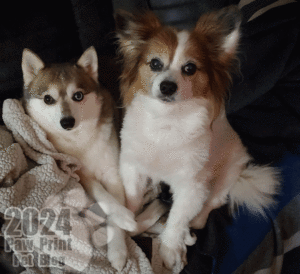
    A Happy Birthday

    Despite being a bit under the weather, I do think Kitsune enjoyed Christmas and his birthday.  It’s so adorable watching him open presents!  He’s a pro at it.  We couldn’t really give him any special foods or treats this year since he’s had an upset stomach, but he got a few toys and an elevated feeder for his food and water bowls.  This happens every year, but I think Kit has more fun opening his presents and playing with the paper than he does with the actual presents themselves!

    Birthday Wishes

    I know I can’t deny that he’s a senior now, but I hope that we still have lots of birthdays left to celebrate with Kitsune!  I’ll do whatever I can to make that happen.  But even more so, I hope that he continues to enjoy life to the fullest.  That his days are cozy and warm, full of snuggles, tasty treats, and fun.  That he always knows how loved he is and feels like he’s part of a pack.

    dog's 15th birthday!

    Adventures Ahead!

    Embarking on life with a senior dog is very much a new adventure for me.  I admit that I haven’t found it to be easy so far.  But I just adore Kitsune, and feel honored to be one of the people that gets to walk his life path with him.  Although our 2024 started off stressful, I’m so thankful that things already seem to be looking up.  I’m looking forward to seeing what adventures the next year has in store for us!

    So Here’s to Kitsune!

    Happy 15th birthday, buddy.  You’ve somehow only gotten more adorable over the years, and are for sure the silliest, most opinionated, active 15 year old dog I’ve ever met.  I give you full permission to drive your ‘brother’ and us humans as crazy as you want going forward.  You know, senior dog privileges!  Old dogs basically can’t get in trouble for anything anymore.  So cause as much trouble as you want, steal all the blankets, bark your little head off at dinner time, and have all the fun!

    Comment below!  When is your dog’s (or other pet’s) birthday and how old will they be?  Do you do anything special to celebrate your pets’ birthdays?

    dog's 15th birthday!

    The Paw Pack

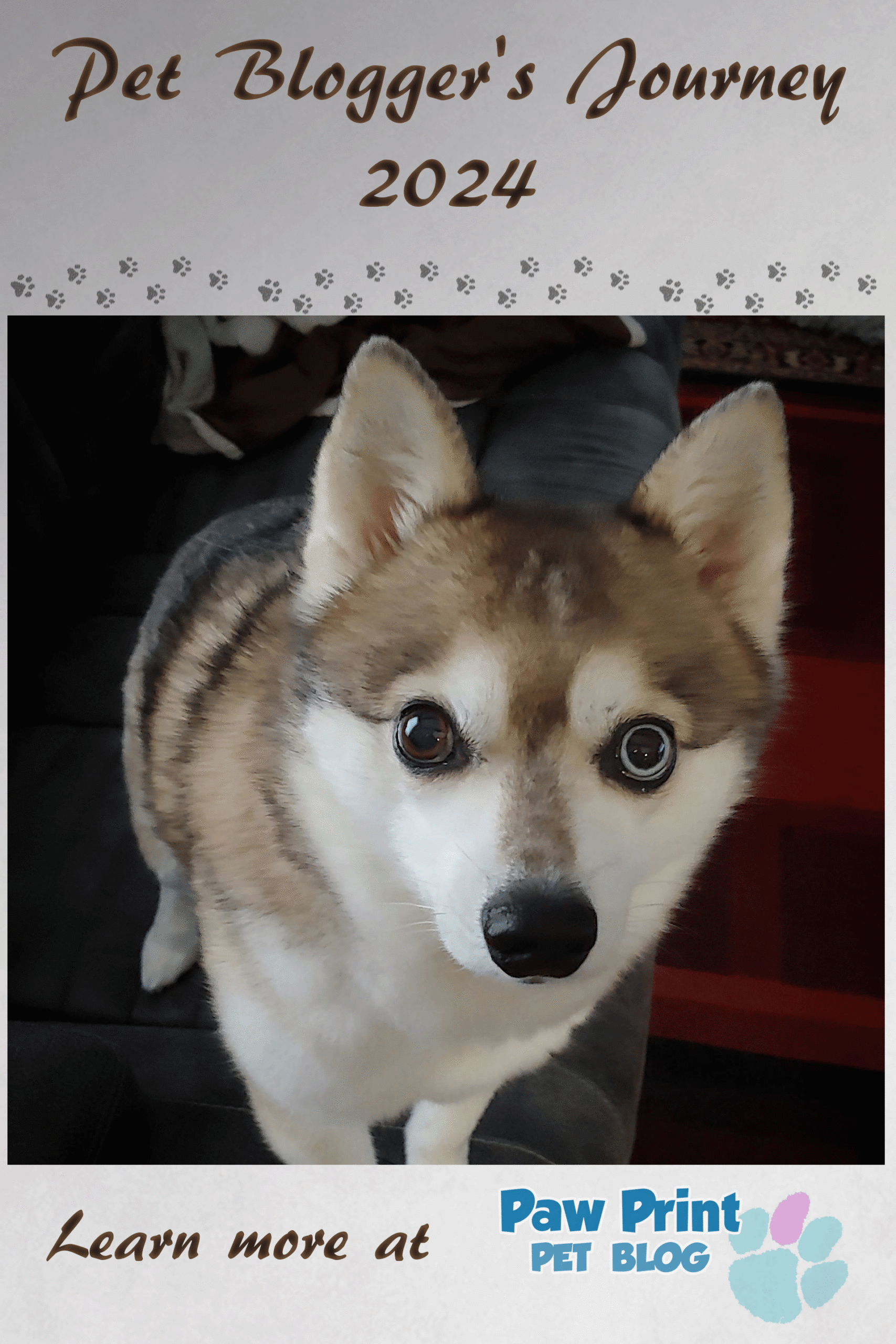
    Pet Blogger’s Journey 2024

    January 4, 2024

    For the past two years, I took part in Puppy in Training’s Pet Blogger’s Journey.  It was a series of questions to answer each year, about your blog in general, goals, and accomplishments over the past year.  I was looking forward to joining the 2024 Pet Blogger’s Journey but it looks like Puppy in Training isn’t hosting it this year.  I was originally going to post anyway and just reuse the same questions from the past two years, but that feels a little stale.  Instead, to celebrate the start of a new year, I figured I’d just post a bit of an update and look back at the Paw Print Pet Pack’s 2023.

    Pet Bloggers Journey 2023

    Pet Bloggers Journey 2022

    Post Contents:

    • 1 The Blog’s Best Year Yet!
    • 2 2024 Blogging Schedule?
    • 3 Goals for 2024?
    • 4 Quick Update on the Dogs
    • 5 Happy 2024!

    The Blog’s Best Year Yet!

    As far as numbers go, 2023 was the blog’s best year yet!  We got exponentially more views, and more top search spot posts than ever before.  I have no doubt that it was due, at least in part, to how hard I worked on updating content on the site throughout 2022 and the early parts of 2023.

    With that being said, I didn’t post as often in 2023 as I have in previous years.  After over 13 (I think, I lost count!) years of blogging about dogs, as you can probably imagine, it started getting a bit harder for me to think of new topics that I had not already covered before!  I think I burnt myself out a bit blogging as much as I did throughout 2022.  That, and the fact that I’ve had to deal with some stressful life stuff, made it harder for me to find the motivation to blog as much as I would have liked too.

    2024 Blogging Schedule?

    As of right now, my plan for 2024 is to stick to my once a week blogging schedule.  But I’m not going to worry too much about giving myself some grace if/when I need to take a break.  So look for new blog posts here every Thursday!  But don’t get too worried if I skip a week every now and again.  Hey, you can always check out our social media pages (links at the top of the page) if you want to keep up with the Paw Pack in real time!  I post most regularly over on our Facebook page.

    Goals for 2024?

    pet bloggers journey 2024Besides hopefully keeping up with blogging at least somewhat regularly, do I have any blog goals for 2024?  To be honest, I have a few projects besides this blog that I’m planning on working hard on throughout the next year.  As far as this site goes, besides just keeping up with blogging, I’m looking forward to continuing the growth of our social pages, and getting to talk to more of you!  It might be overly ambitious, but I decided that I want to try to post new Kitsune content daily!  Most of the time that’s going to consist of new Instagram photos of him.  But it will mean lots of  new Youtube videos too!
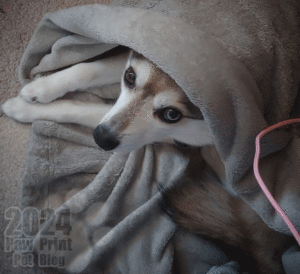
    I’m doing this partly for myself, because I realized lately that Kit is getting old, and I don’t want future me to regret not taking enough photos/videos of him at this life stage.  And partly because I really want to document and show what day to day life with a senior dog is like – the good and the bad.  I feel like too often people on the internet feel like they have to present the perfect life.  But dogs, and our lives with them, are not perfect.  That’s probably especially true with senior dogs and I know that, in the past, I’ve held off on posting photos of Kit for stupid reasons, like his eyes looking overly cloudy in certain lighting.  But I want to try to show more of what life with a little old man dog is really like – attitude, messy hair, cloudy eyes and all.

    Quick Update on the Dogs

    Kit turned 15 on December 26th.  I haven’t posted very much about his birthday yet.  Mostly because, unfortunately, Kit (and in extension me!) has been having a bit of a rough time the last couple of weeks.  Kit’s been sick, and it took longer than I would have liked to really pinpoint what was going on.  I think, fingers crossed, that we’re finally on the right path to getting him back into fighting form.  He’s had a few really good days in a row this week and seems to finally be feeling a lot better.  The last couple of weeks have been kind of sad, and stressful, and expensive!  I feel like it really put a damper on the holidays and celebrating Kit’s birthday this year, to be honest, although we tried to make the best of things.  But Kit is ok!  He’s currently snuggled up taking a nap on the bean bag in my office as I type this.  I’ll post more about the health issues he’s been dealing with in a future post.

    pet bloggers journey 2024Fenrir is doing so well that I almost feel like I don’t have anything to update about for him.  He’s just been his normal, hyper, playful, ornery, silly self.  Having him to keep me on my toes while Kit wasn’t feeling well has been good for my heart.  Some days just throwing a ball around with Fen out in the yard, or taking him out for a romp around the woods, was just what I needed to destress.  Oh, in case you’re wondering, since Kit is hogging the bean bag Fen is currently curled up with his head on my foot, underneath my desk.  He lays there a lot while I’m working on my computer.  My adorable little shadow.

    Happy 2024!

    Kit, Fen, and I hope that everyone has a fun, happy, healthy 2024!  Comment below.  How did you celebrate new year’s eve?  What are some of your hopes, wishes, and goals for the upcoming year?  Thanks, as always, to everyone who stops to visit our little corner of the internet.  We hope you continue to visit, when you can, in 2024!

    pet bloggers journey 2024


    Senior Dogs

    5 Tips for Keeping Your Senior Dog Healthy & Happy

    December 21, 2023

    My amazing papillon, Kitsune, will turn 15 the day after Christmas this year.  If you follow us on Facebook, you might know we’ve been dealing with some health issues with Kit lately.  Thankfully, though, all things considered, Kit is doing quite well for an older gentleman.  If it’s true that one human year is equal to seven dog years, Kitsune is approaching the ripe old age of one hundred and five!  You’d never guess it by looking at him, though.  Kit still loves running zoomies around the house, wrestling with his little brother Fenrir, and exploring in the woods.  Oh, and begging for food.  He still begs with all the enthusiasm of a puppy!

    Whether you share your life with a distinguished senior “pup”, or are just embarking on the adventure of raising a puppy, everyone wants their dog to live as long as possible!  Dogs’ one flaw indeed is that they don’t live as long as we do.  Luckily, there are some things you can do that can not only potentially help your senior dog to live longer, but can help make your best friend’s golden years happier as well!

    Post Contents:

    • 1 Feed Your Dog High-Quality Food
    • 2 Supplement as Needed
    • 3 Pain Control as Needed
    • 4 Appropriate Exercise
    • 5 Mental Stimulation
    • 6 Comment below!

    Feed Your Dog High-Quality Food

    I don’t generally recommend specific dog food brands on my blog.  I wrote a whole post about why this is the case, summarized by the fact that each dog, and each dog owner, are individuals.  I am a huge proponent of feeding the dog in front of you.  What’s right for one dog isn’t going to be what’s right for all.  Different dogs have different needs, and different owners are going to have different living situations too.  Not every owner wants to, or can, spend hours a week home cooking complex diets for their dogs.  Not everyone can afford the most expensive super premium dog foods, especially if you’re feeding a large breed dog.  And not every dog is even going to do best on these types of diets!

    When it comes to feeding dogs, senior dogs or otherwise, my advice to owners is to do the best you can for your dog.  Research, talk to your vet and/or a dog nutritionist, and experiment a bit with different foods.  Research, and find the diet that works the best for you and your dog!

    I recently changed Kitsune’s diet a bit based on his current needs.  One of his most recent health issues warranted a food switch for him.  That’s another thing to keep in mind, what works best for your dog now might not always be the perfect food for him/her.  As your dog’s health and needs change, what diet works best for them will likely change as well.

    Supplement as Needed

    I’ve always, at least partly, attributed Kitsune’s health and vibrance well into his teens to the supplements I use to help support him.  Kitsune has had arthritis for years, for example, but thankfully we’ve been able to avoid pain medications such as NSAIDs by using supplements such as Dasuquin, a high quality omega-3 supplement, and turmeric.  Supplements often come with a lot less potential side effects than medications, but can be effective at treating some health issues.  Other supplements don’t so much treat issues as help support our pet’s natural systems.  I give my dogs a mushroom supplement, for example, to help support their immune systems and for general health.

    Like with food, supplements should be catered for your individual dog.  I have two dogs, and I don’t give them the same supplements.  I base what supplements I give to each of my dogs on their unique, individual needs.  Remember that it is possible for supplements to interact with certain medications, and with each other.  If you are unsure about whether a supplement is safe to offer your dog you should discuss it with your pet’s vet.

    Pain Control as Needed

    Getting old can suck sometimes.  Dogs, like humans, are prone to developing age related conditions that can, unfortunately, cause discomfort and pain.  While I do prefer using more natural supplements and treatments when possible, owners should not be afraid to talk to their vets about stronger pain control options if/when they are needed.  Please don’t allow your senior dog to suffer in pain when their are options to keep them more comfortable!

    Keep in mind that pain control doesn’t always have to come in the form of medications either.  Depending on your dogs condition, sometimes alterative treatments such as laser therapy, physical therapy, and acupuncture can be great ways to help manage pain.  No matter what form of pain control you go with, find something that works for your dog.  No one wants to see their beloved senior pup in pain, and eliminating chronic pain can go a long way towards improving an old dog’s qualify of life.

    happy senior dog

    Appropriate Exercise

    Senior dogs don’t typically have the same exercise requirements as their younger counterparts, especially when/if they experience any health issues or effects of old age.  That doesn’t mean, however, that senior dogs shouldn’t be exercised at all.  Over a year ago now, when my senior, Kitsune, was diagnosed with cervical IVDD, he required 8+ weeks of really strict rest.  After 8 weeks, his vet gave us the go ahead to slowly start working Kit up to being able to exercise again.  The amount of exercise he receives now, however, post  IVDD and with arthritis, looks different than when he was younger.

    On an average day, Kitsune gets three walks a day of about 20 minutes each.  A few times a week we take him on short, easy hikes, or allow him to spend more time outdoors exploring in the woods.  Light exercise, that they can handle without getting sore, can be really beneficial for senior dogs.  In fact, out vet attributes the fact that Kit moves so well despite having pretty advanced arthritis with the fact that he gets regular exercise.  Regular, low impact, exercise can help keep muscles strong and can reduce the amount of pain and stiffness that is associated with age related conditions, notably arthritis.

    Remember that, while regular exercise can be very beneficial for senior dogs, don’t overdo it.  If your dog is not currently used to exercising it’s best to take things slow and work your way up to a moderate, regular exercise routine.  Low impact exercises such as walking, swimming, and gentle play often work best for older dogs, especially older dogs with joint, or other health, issues.  Talk to your dog’s vet if you have any concerns or questions about how much, and what types, of exercise your individual dog can tolerate.

    Mental Stimulation

    happy senior dogAlthough I’ve listed it last, I think this is one of the most important tips for keeping your senior dog happy and healthy!  Mental “exercise” can be just as important as physical exercise is.  One thing I’ve been super thankful for is the fact that, although he’s experienced some physical limitations in his older age, mentally Kit is the same dog now that he’s always been.  I make it a point to keep him entertained and engaged on a daily bases.  Because, let’s face it, mental health is important.  Your dog, no matter his age, isn’t going to be as happy as he could be if he’s just sitting around doing nothing day after day.
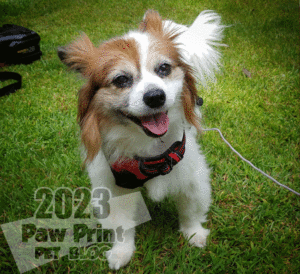
    Providing mental stimulation can sometimes be more challenging if you have a senior dog with physical limitations.  I struggled a bit, for example, with Kit when he was healing from his IVDD.  I couldn’t take him for walks, or even give him toys or chews because he had to make sure he was moving his neck as little as possible.  During his IVDD recovery, I played music for him, put the TV on, and spent as much time as possible with him so he wouldn’t feel lonely.

    Once he recovered and got the all clear from his vet, we graduated to low impact sniff walks around our neighborhood, chews and toys, training sessions, nose work, etc.  Thankfully there are a lot of lower impact activities you can do with older dogs to help keep them mentally stimulated.  Old dogs very much can learn new tricks, and I still regularly do training sessions with Kitsune.  As a senior he learned nose work.  He loves going out in the woods around our house with me to look for shed deer antlers.  He loves his daily walks, although they are at a slower pace now than they used to be.  Even just spending some extra time sniffing around the yard can be really rewarding for a dog.

    Regular mental stimulation helps keep senior dogs happier!  And in dogs, like in people, positive emotions like happiness can actually help us lead healthier lives.  Positive emotions are thought to help promote a stronger immune system, and they may even help guard against disease such as cancer!

    Comment below!

    Remember that if you have any questions or concerns about whether your senior dog can tolerate a new food, supplement, or exercise routine it’s important to consult with his/her veterinarian.  It’s important to recognize our senior dog’s limitations, because the last thing we’d want to do is make them sick with a new food or supplement or overdo a new exercise and cause them pain.  

    If you have a senior dog, what are some things you do to keep him/her healthy and happy?  What are some challenges you’ve faced as your dog has aged, and how did you overcome those challenges?

    happy healthy senior dog

    We’ve, unfortunately, been dealing with content scrapers stealing our articles. You shouldn’t be seeing this article on any site other than pawprintpetblog.com! If you’re reading this article on any other site, we’d love for you to take the time to contact us and let us know and, if you have the time, stop by and visit us on our official site! Thanks you.

    Dog Health, Kitsune, The Paw Pack

    Kitsune’s IVDD Diary – 1 Year Update

    December 7, 2023

    On Saturday, September 17th, 2022, my beloved papillon Kitsune was diagnosed with cervical IVDD.  Due to a number of factors, including his age, other health concerns, and the fact that he, thankfully, was only diagnosed with stage I – II IVDD, we decided to treat Kit conservatively.  In Kit’s case, he never lost mobility but experienced a bit of wobbliness and a lot of pain.  His treatment entailed medications to help keep him comfortable and pain-free, as well as to help reduce the swelling around his spine.

    This past September marked the one-year point since Kit’s IVDD diagnosis!  If you want to look back on his IVDD Diary and see what we dealt with during his recovery, you can do so here:

    Post Contents:

    • 1 Kitsune’s IVDD Recovery Diary:
    • 2 Our 1-Year Update!
    • 3 Our IVDD Precautions
    • 4 What About Exercise?
    • 5 IVDD Is Not a Death Sentence!
    • 6 Check Out Our Informative IVDD Posts:
    • 7 What Do You Want to Know About IVDD?
    Kitsune’s IVDD Recovery Diary:
    • Kitsune’s IVDD Recovery Week 1
    • Kitsune’s IVDD Recovery Week 2
    • Kitsune’s IVDD Recovery Week 3
    • Kitsune’s IVDD Recovery Week 4
    • Kitsune’s IVDD Recovery Weeks 5 & 6
    • Kitsune’s IVDD Recovery Weeks 7 & 8

    Our 1-Year Update!

    dog IVDD 1 year updateAlthough I have posted other, more informational IVDD posts since our week 7 & 8 update posts, I don’t think I’ve sat down and written any other updates since then.  By the end of his 8 weeks of recovery time, Kit was fully off of all IVDD-related medications.  He was pain-free and we were given the all-clear to slowly start building up his exercise tolerance again.



    Thankfully, one year since diagnosis, on the IVDD front Kit has been doing well!  In the past year (and 2 months) he hasn’t had any additional IVDD flare-ups.  His mobility is pretty normal, especially for an almost 15-year-old dog who also has arthritis.  Since his IVDD diagnosis, once in a great while I’ll notice him miss a step with one of his front legs.  But it doesn’t happen that often and isn’t anything that holds him back any.

    Our IVDD Precautions

    For awhile I gave Kit a supplement that I was hoping would help prevent another IVDD flare up.  I did end up taking him off of it, however, and haven’t noticed any differences one way or the other since doing so.

    We try to avoid allowing Kit to do things that will put too much impact on his back/neck/spine.  That includes going up and down the stairs, and jumping on and (especially) off of furniture.  It helps that Kit is such a smart cookie!  I quickly trained him to “ask” for help getting on or off the furniture or up and down the stairs.  Thankfully he’s a small dog, so I have no problem lifting him as needed.

    Speaking of being a small dog.  A big part of (hopefully) avoiding another instance of IVDD has been helping Kit to loose weight.  He was on steroids as part of his IVDD treatment which, as it turned out, really didn’t agree with him.  Among other side effects he did end up gaining weight during his recovery.  However, he’s lost 2lbs over the last 6 months!  I know that doesn’t sound like a lot, but it’s a lot for a small dog.  That’s 9% of his body weight!  I have to admit I was quite proud during his last vet visit when the vet didn’t need to spend time scolding us for having an overweight dog.

    What About Exercise?

    Since Kit’s IVDD diagnosis I’ve spoken with quite a few other IVDD dog owners and experts.  Some of them seem to severely limit their dog’s exercise/activity after IVDD, while others pretty much return to life as usual.  After talking a lot with Kit’s vet, I decided that I didn’t want to let the potential of a future IVDD flare take away from Kit’s enjoyment of life.  He loves spending time outside, exploring the woods, wrestling with his brother.  And, for the most part, we still allow him to do all those things.  I’m more careful about what types of trails we take him out on during walks.  These days, we try to stick to flatter trails that don’t have a lot of logs/rocks/etc. that Kit would have to jump or scramble over.  But, with a few minor restrictions, we do still allow Kit to exercise and play.

    dog IVDD 1 year update

    IVDD Is Not a Death Sentence!

    Years ago, when less was known about IVDD than today, many dogs who presented to a vet with IVDD symptoms were euthanized.  It can be a very painful condition that limits mobility, which can be hard things for dogs and owners alike to deal with.  However, a lot more is known about IVDD now, including the fact that many dogs can recover from an IVDD flare and go on to live pain free, happy lives.  Researching IVDD can be scary for owners because a lot of the available information is a bit overwhelming, especially when you look up what surgery for IVDD entails and associated costs.

    IVDD is not an easy diagnosis to deal with for sure.  Even the much cheaper conservative treatment option, what we did with Kit, take weeks of recovery.  It’s stressful, especially if you’re anything like me and just hate seeing your dog in any amount of discomfort or pain.  But, thankfully, there is hope!  With time, patience, a good vet, lots of love, and a little luck, dogs, like my Kitsune, can do very well after a IVDD diagnosis.

    Check Out Our Informative IVDD Posts:

    • What is IVDD?
    • Signs Your Dog Has IVDD
    • How is IVDD Diagnosed in Dogs?
    • Treating IVDD in Dogs

    What Do You Want to Know About IVDD?

    Whether you and your dog are dealing with an IVDD diagnosis yourselves, or you’re just looking to learn more, what types of IVDD related posts would you like to see here in the future?  I’m keeping my fingers crossed that Kitsune doesn’t ever have to deal with another IVDD flare up!  But I’ve learned a lot about this disease over the past year, and I’m happy to share that information here.  If you have any specific questions please feel free to post them in the comments!  I will try to either answer them all directly, or else put up a separate post.

    Dog IVDD 1 year update

    Pet Tips

    How I Wash My Dogs’ Plush Squeaky Toys

    November 16, 2023

    It’s been a while since I last posted here!  Life has just been a bit hectic.  I’m sure most people can relate.  Recently, both my partner and I ended up coming down with Covid.  Thankfully, we’re both on the mend and will hopefully be fully back in fighting form soon.

    Ever since I felt well enough too, I’ve been on a bit of a cleaning frenzy.  Gotta get rid of all those germs!  Although the data I’ve looked at suggests that it’s rare for dogs to suffer from Covid-related symptoms, one can never be too safe.  My cleaning has included my dogs’ stuff, such as their bedding and toys.  I guess if there was one “good” thing about getting Covid, it was that the timing worked out well.

    At least once a season I like to go through my dogs’ toys.  I throw out any that are broken.  Then I wash all their toys before deciding which I will keep out, and which I’ll put in storage while doing toy rotations.  I must admit, I used to destroy quite a few of my dogs’ toys while cleaning them.  Especially plush squeaky toys, which are both of my dogs’ favorite kinds of toys.  Luckily for Kitsune and Fenrir, these days we rarely ever have toy casualties on cleaning day.  Over the years I’ve seemingly perfected my plush squeaky toy cleaning technique!

    Post Contents:

    • 1 Why Clean Your Dogs’ Toys Anyways?
    • 2 How to Clean Plush Dog Toys
    • 3 I clean my dogs’ plush toys in the washing machine and dry them in the drier.
    • 4 What soap products should you use to wash plush dog toys?
    • 5 How Often Should You Wash Your Dog’s Plush Toys?
    • 6 Toy Wash Day is The Best Time for Toy Checkups!
    • 7 Do Your Wash Your Dog’s Plush Toys?

    Why Clean Your Dogs’ Toys Anyways?

    According to NSF (National Sanitation Foundation) International, pet toys are one of the top 10 germiest items in our homes!  NSF states that…

    Pet toys were a source of coliform bacteria (including Staph bacteria), yeast and mold in many homes.

    Yuck!  Nobody wants bacteria from their dogs’ toys spread throughout their home.  Exposure to bacteria, yeast, and other fungi from dog toys can potentially make you sick.  And it’s no great secret that dogs play with their mouths.  That makes dogs especially prone to pathogen exposure from dirty toys.

    Affiliate Disclosure

    How to Clean Plush Dog Toys

    Cleaning hard dog toys, such as rubber Kongs, is pretty straightforward.  But what about plush toys?  How can you clean plush dog toys without destroying them, matting down the fur of fuzzy stuffed animals, or preemptively killing squeakers?

    I clean my dogs’ plush toys in the washing machine and dry them in the drier.

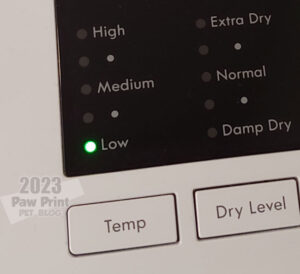
    wash plush dog toysThe secret to washing dog toys (and other soft, fuzzy, plush fabric items as well) in your washing machine is cold temperatures!  Hot water in your washing machine, or putting your drier on a high heat setting, can melt the fibers of plush toys.  Heat is especially damaging to really fuzzy plushies.  When I wash my own dogs’ toys I use cold water in my washing machine, and the lowest heat setting on my drier.
    What soap products should you use to wash plush dog toys?

    Again remember, dogs play with their mouths!  They also have an ultra sensitive sense of smell.  Any detergents you use will leave at least small amounts of soap behind on whatever you wash.  My safer alterative, go-to cleaning products for washing my dogs’ toys are pretty basic – baking soda and/or vinegar!  Most often I’ll use a bit of vinegar in my washing machine.  I don’t love the smell of vinegar, but it can be a great odor eliminator and leaves my dogs toys looking fresh and clean.  Thankfully, the vinegar smell doesn’t linger once the toys are clean and dry.

    If you prefer, you can also use more traditional laundry detergent that’s marketed for people who are sanative to chemicals and strong odors.  These are typically marketed as “free & clear”, hypoallergenic, or sensitive skin formulas of detergent.

    The NSF recommends that dog toys be washed in diluted bleach (half a tablespoon of bleach to one gallon of water) or washed in your washer’s sanitizing cycle.  Use caution with bleach and hot wash cycles, though, as both of these things have the potential to destroy plush dog toys.  Use your best judgement on how each individual toy should be washed.  Toys made of tougher fabrics that are not particularly fuzzy have a higher chance of surviving hot wash cycles fully intact.  Bleach will, of course, discolor most fabric items.  You also must be sure to fully rinse all bleach off your dog’s toys.

    How Often Should You Wash Your Dog’s Plush Toys?

    wash plush dog toys“As needed” is the simplest, yet not super helpful answer.  The NSF recommends that dog toys be washed monthly, or even more often as needed.  I have to admit I don’t wash my dogs’ plush toys that often.  Besides a handful of favorites, my dogs don’t play with all of their toys on a daily bases.  So while some see a lot of play hours, others hardly get touched in the span of a month.
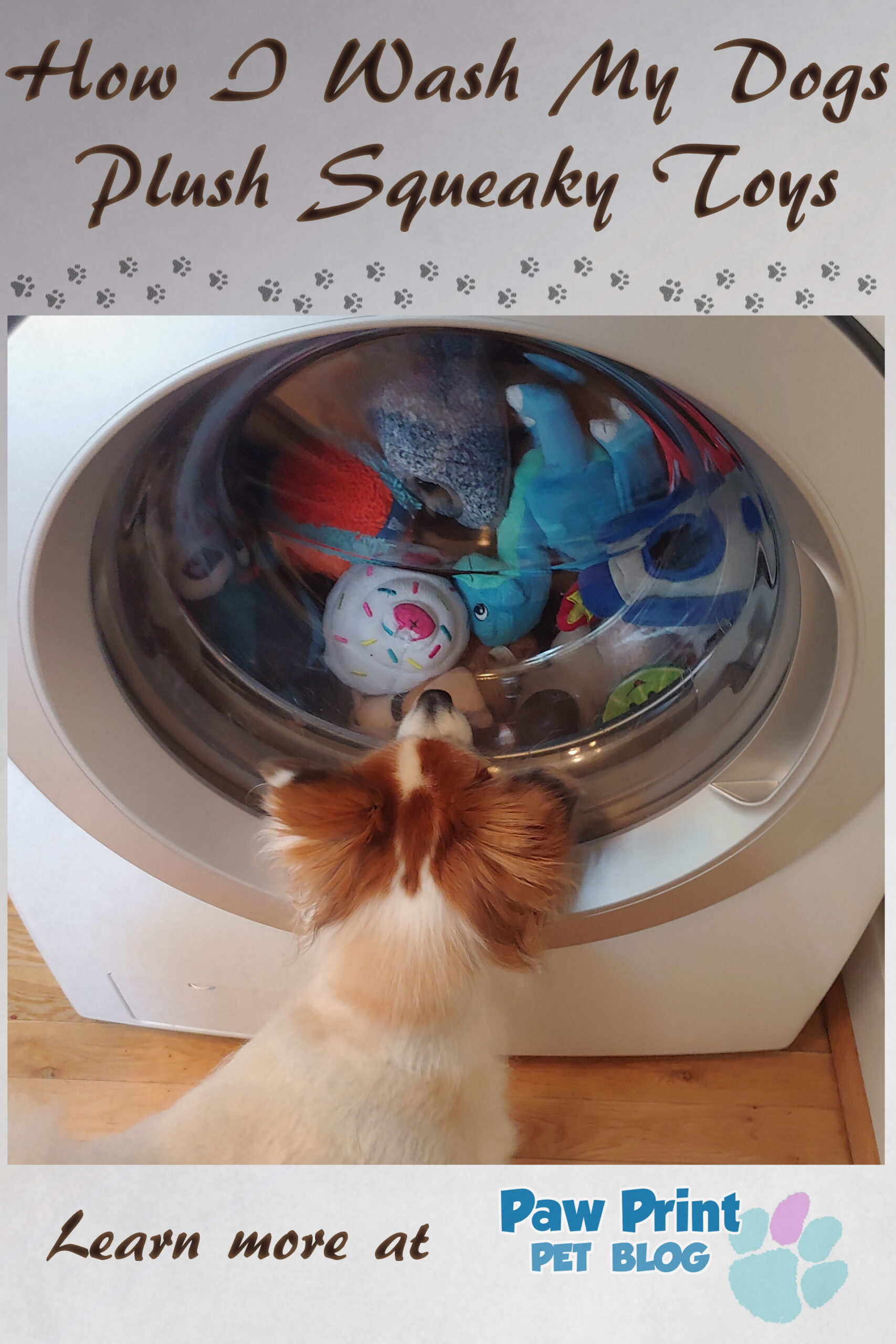
    I use my best judgement as to how often each toy needs to be cleaned.  My Alaskan Klee Kai, Fen, has a handful of favorite toys that he plays with daily.  I wash those much more often then many of our other dog toys.  Whether they need it or not, I do wash all of my dogs’ toys once a season.  So at least once every 3 months.

    It’s important to keep your dog’s toys clean, but washing plush toys in the washing machine more often will ultimately decrease their lifespan.

    Toy Wash Day is The Best Time for Toy Checkups!

    Even if you don’t rotate your dog’s toys like I do, toy cleaning day can be a great way to preform a quick checkup on all your dog’s toys.  Look out for toys that are too worn out, or no longer safe in some way.  I usually throw plush toys out once they have been destuffed, ripped open, or if they have any damage that may make them unsafe (such as a lot of loose strings or exposed squeakers).  Keep playtime safe for your furry best friend!

    Do Your Wash Your Dog’s Plush Toys?

    Comment below!  What is your dog’s favorite toy?  How often do you wash your dog’s toys?  Do you have a special cleaning technique, or certain products you use to keep your dog’s toys clean?

    wash dogs plush squeaky toys

    We’ve, unfortunately, been dealing with content scrapers stealing our articles lately. You shouldn’t be seeing this article on any site other than pawprintpetblog.com! If you’re reading this article on any other site, we’d love for you to take the time to contact us and let us know and, if you have the time, stop by and visit us on our official site! Thanks you.

    Adventure Dogs, Small Dogs

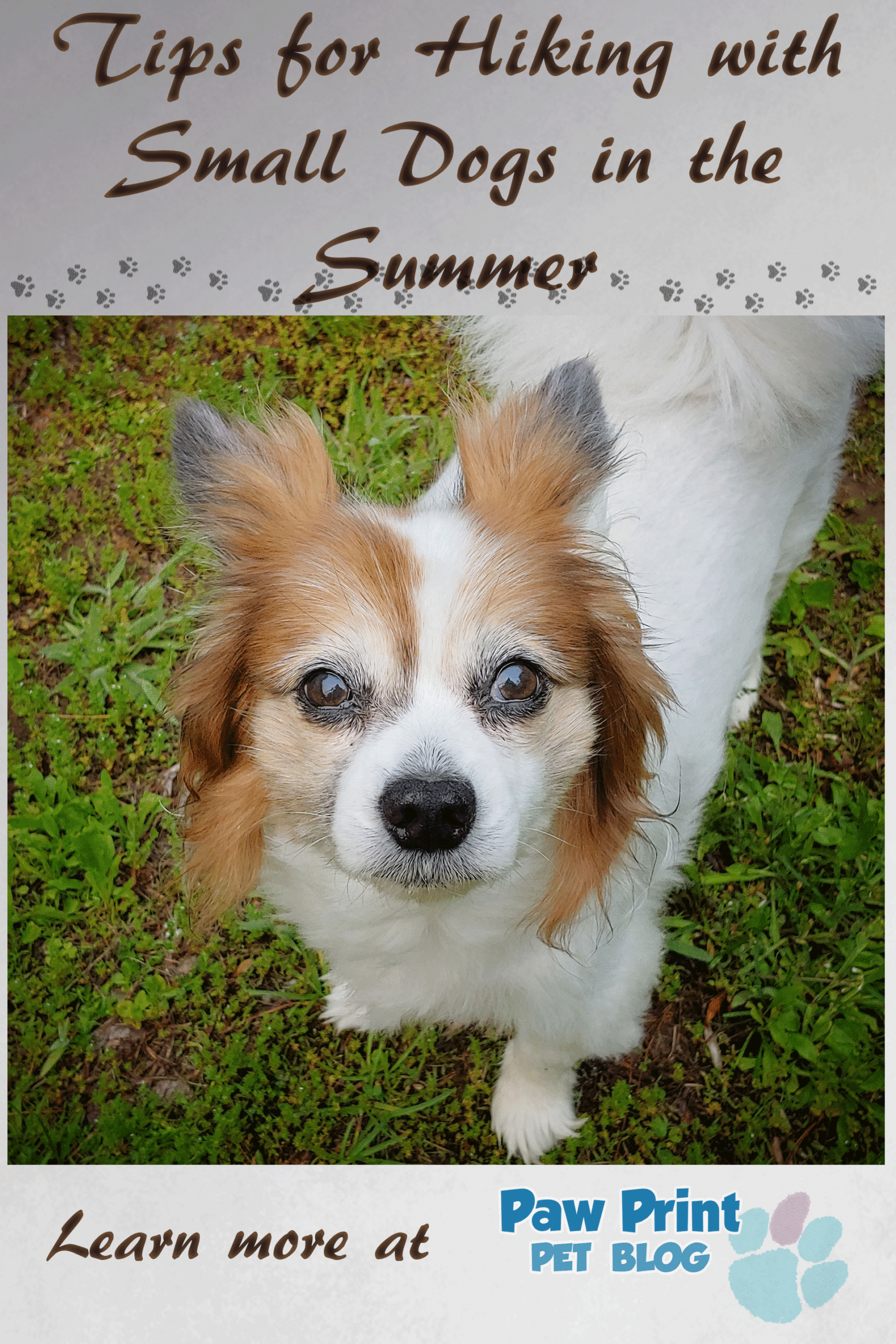
    Tips for Hiking with Small Dogs in the Summer

    August 31, 2023

    Has this summer been crazy where you live?  We got an insane amount of rain.  It felt like we lived in a rainforest!  It rained almost daily, which caused a lot of issues with flooding.  Then, once the rain totals finally started to somewhat return to normal, we got about a week of super hot and humid weather.  Immediately after that, it started to feel like fall!  As you can imagine, all the rain, and then the super hot weather put a damper on summer hiking.  Luckily for us, summer isn’t quite over yet!  Now that Mother Nature has seemingly decided to give us a bit of a break in the crazy weather, we’ve been trying to get in as much summer hiking as possible!

    Post Contents:

    • 1 Can You Hike with Dogs in the Summer?
    • 2 Honestly Assess Your Dogs’ Hiking Abilities
    • 3 Keep a Close Eye on the Weather
    • 4 Hike During Cooler Times of the Day
    • 5 Choose Terrain Carefully
    • 6 Pack Appropriately
    • 7 Protect Your Dog’s Paws!
    • 8 Know What Dangers to Look Out For in Your Area
    • 9 Know the Signs of Heat Related Illness
    • 10 Check Out Some of My Other Hiking & Summer Safety Posts:
    • 11 Comment Below!

    Can You Hike with Dogs in the Summer?

    The key to a fun, safe hike with your pooch, no matter the time of the year, is vigilance and preparation.  I know, I know, boring, right?  But each season can present different dangers to your dog that you should be aware of.  An enjoyable hike is one where everyone comes home safely, albeit probably exhausted.  You can hike safely with dogs in the summertime, as long as you prepare and follow safety precautions.

    Honestly Assess Your Dogs’ Hiking Abilities

    If you haven’t taken your dog hiking for a while, don’t just jump into summer hikes head first.  Hey, I get it.  The warm sunny weather makes most people want to spend more time outdoors.  But, like people, dogs who have not exercised much in a while may not physically be up to embarking on a long hike right off the bat.  Hiking with dogs who are not (yet!) physically up to the challenge is a good way for your dog to get injured.  Start small and work your way up to more rigorous/longer hikes.  Over time your dog will build up stamina and be able to take on more intense hikes.

    Be realistic about your dog’s physical condition.  Keep in mind that some dogs, for numerous reasons, just may not be able to tolerate really intense or long hikes.  Be especially careful with older/senior dogs, and young dogs who are inexperienced with hiking.  Older dogs can be especially sensitive to high heat and humidity.  Dogs with long hair or double coats, or those with short muzzles can also overheat easily.  Dogs with very short coats, however, are more prone to sunburn.  Be honest when assessing your dog’s physical condition and hiking abilities, so that you don’t push them too hard during hikes.

    hiking small dogs summerKeep a Close Eye on the Weather

    This seems like common sense, but how hot is too hot for a dog?  It can depend on a lot of factors, some of which I’ve already mentioned.  Different dogs respond to different temperatures…well…differently!  You have to keep an eye on other factors too, such as the humidity.  This chart shows a general recommendation for what temperatures/humidity levels are too high for dogs.  But, again, think about your individual dog!  My double coated Alaskan Klee Kai, Fenrir, for example, has a pretty low heat tolerance.  He starts getting uncomfortably hot in temperatures that other dogs seem to tolerate well.

    Keep an eye on other types of weather as well, such as whether it’s  going to rain or be excessively windy.  We live in an area where a lot of the hiking trails are quite rocky.  I personally avoid hiking on days when I know it’s going to rain because the wet rocks often become slippery.

    Hike During Cooler Times of the Day

    In the summer the mornings and evenings are usually the coolest parts of the day.  On days that are supposed to get hot, but I really want to hike, I’ll opt for a nice early morning hike.  Just before sunrise seems to be the coolest time of the day.  As an added benefit, not many other people are up that early so you don’t have to worry as much about traffic on the roads or hiking trails!

    Choose Terrain Carefully

    We live in an area with lots of mountains, which I love!  But when the temperatures are raising I generally try to stick to easy, low elevation hikes.  High altitude hikes are usually more strenuous, and the heat can feel more intense at higher elevations.  Lower elevation hikes have the added benefit of often being closer to bodies of water!  Just be careful to avoid blue-green algae if you allow your dog to play in, or drink from, bodies of water during hikes.

    On warmer days, try to select trails with more tree cover.  Temperatures are usually cooler in the shade, and avoiding being out in intense sun can help prevent sunburn (for you and your dog!).

    Pack Appropriately

    I don’t usually love bringing a ton of things with me when I hike, but when it comes to summer hiking with dogs there are for sure some essentials.

    • Water: And plenty of it!  This is, in my opinion, the most important thing to bring on a summer hike.  Make sure you have enough water for yourself as well as your dog.  Water can be used to help cool your dog down if s/he overheats, so bring extra if you can.
    • Food:  Especially during longer hikes, I always pack at least a snack for my dogs.  Hiking in the heat can deplete energy faster.  My dogs always seem thankful for their hike snacks.
    • Pet First Aid Kit: In the summer I always make sure to include bandanas in my dog first aid kits.  The bandanas can be soaked in water and tied around your dog’s neck to help them cool down.
    Protect Your Dog’s Paws!

    Affiliate Disclosure

    Did you know that dogs can burn their paw pads if they’re exposed to hot surfaces?  In the summer certain surfaces can heat up enough to burn dog’s paws.  Pay special attention to dark surfaces such as pavement and rocks, especially if they are located under direct sun.  You can use products such as Musher’s Secret or dog booties to help protect your dog’s paws from burns.

    I don’t normally but boots on my dogs while we’re hiking, but I keep a few pairs of Pawz disposable dog boots in my dog first aid kit.  They are small and easy to carry, fit my small dogs well, and are waterproof.  They work great if you’re on the trail and your dog gets a paw injury that you need to protect from the elements.

    Know What Dangers to Look Out For in Your Area

    Depending on where you live, you may have location dependent dangers to look out for while hiking.  It’s always a good idea to learn about potentially dangerous animals in your location, such as venomous snakes or large predators.  Some plants, such as poison ivy, oak, and sumac are potential threats too.  If you haven’t already, do your research to learn about potential threats to you and your dog that are relevant to your location.

    hiking small dogs summer

    Know the Signs of Heat Related Illness

    Keep a close eye on your dog while spending time outdoors in the heat.  If your dog is acting slow or tired, that’s usually a good sign that they, in the very least, need a bit  of a break.

    Heatstroke can be deadly, so it’s important to know the signs.  If your dog experiences any of the following symptoms it’s important to get them inside in a cool location and contact your vet ASAP:

    • Excessive,  hard panting
    • Extreme fatigue
    • Rapid heart rate
    • Excessive drooling and/or thicker than normal saliva
    • Disorientation or confusion
    • Dizziness
    • Red or pale mucous membranes such as gums, lips, or tongue
    • Vomiting or diarrhea
    • High temperature (over 104*F)
    • Collapse, seizure, or coma
    Check Out Some of My Other Hiking & Summer Safety Posts:
    • 10 Tips to Help Your Dog Beat the Summer Heat
    • Exercising Your Dog Indoors
    • Keeping Your Pet Cool – Summer Safety Tips
    • Dogs Can Die in Hot Cars
    • Tips for Hiking with Small Dogs in Bear Country

    Comment Below!

    Do you hike during the summertime with your dog(s)?  What are some safety tips you follow to keep your own hikes safe and fun?

    Kit, Fen, and I hope that everyone enjoys what’s left of the summer.  Happy hiking! 🙂

    hiking small dogs summer

    We’ve, unfortunately, been dealing with content scrapers stealing our articles lately. You shouldn’t be seeing this article on any site other than pawprintpetblog.com! If you’re reading this article on any other site, we’d love for you to take the time to contact us and let us know and, if you have the time, stop by and visit us on our official site! Thanks you.

    Alaskan Klee Kai, All About Dogs

    Are Alaskan Klee Kai Cuddly?

    August 3, 2023

    Do you prefer dogs who are cuddly?  Or maybe you prefer breeds who are more independent?  I have to admit, I’m kind of a sucker for a cuddly pup.  There’s nothing I love more than snuggling up with my dogs and a good book at the end of a long day.  I lucked out with my first dog, Kitsune, a papillon.  He loves cuddles!  But what about my second dog, Fenrir?  Are Alaskan Klee Kai typically cuddly dogs?

    • Alaskan Klee Kai Breed Profile

    Post Contents:

    • 1 More Than Just “Mini” Huskies
    • 2 First Thing First, What Do I Mean By “Cuddly”?
    • 3 One Person Dogs
    • 4 Klee Cats?
    • 5 One Size Doesn’t Fit All
    • 6 Conclusions

    More Than Just “Mini” Huskies

    Although they may look it, Alaskan Klee Kai are not, in fact, just miniaturized Siberian huskies.  The breed was originally created by mixing both Siberian and Alaskan huskies with smaller American Eskimos and schipperkes.  Because of this, the personalities of Alaskan Klee Kai (AKK) tend to be all their own.  A mix, if you will, of all the breeds that went into creating them more so than miniatured versions of any one breed.

    Alaskan Klee Kai cuddly

    If you know anything about northern breeds such as Siberian and Alaskan huskies, you can probably start to surmise that Alaskan Klee Kai can be pretty high energy little dogs.  Siberian and Alaskan huskies are working sled dog breeds.  Schipperkes are a small breed of dog that were traditionally used as ratters and watchdogs.  American Eskimos are known for being intelligent, versatile dogs that can expertly play many rolls.  Everything from companions to farm dogs.

    So what does that mean for Alaskan Klee Kai?  Can a breed made up of such driven, hard working, high energy breeds ever enjoy a good snuggle?

    First Thing First, What Do I Mean By “Cuddly”?

    As I wrote in my past post about papillons…

    Dogs can be affectionate without being snuggly.  To me, a snuggly or cuddly dog is one that enjoys laying in my lap or next to me, receiving attention, for an extended period of time.  Does “cuddly” mean the same thing to you?  I’d be interested to hear if other people would define a cuddly dog differently.

    One Person Dogs

    Alaskan Klee Kai CuddlyI think one thing that’s important to keep in mind when it comes to AKK is that these dogs are very often “one person dogs”.  My AKK, Fenrir, loves my partner but there is 100% no doubt that I am Fenrir’s person.  While Fen enjoys spending time, especially playing, with my partner, he isn’t usually as affectionate with my partner as he is with me.  Fen is basically my little shadow, following me around the house, always by my side.  Fen snuggles with me quite often, but almost never cuddles with my partner.
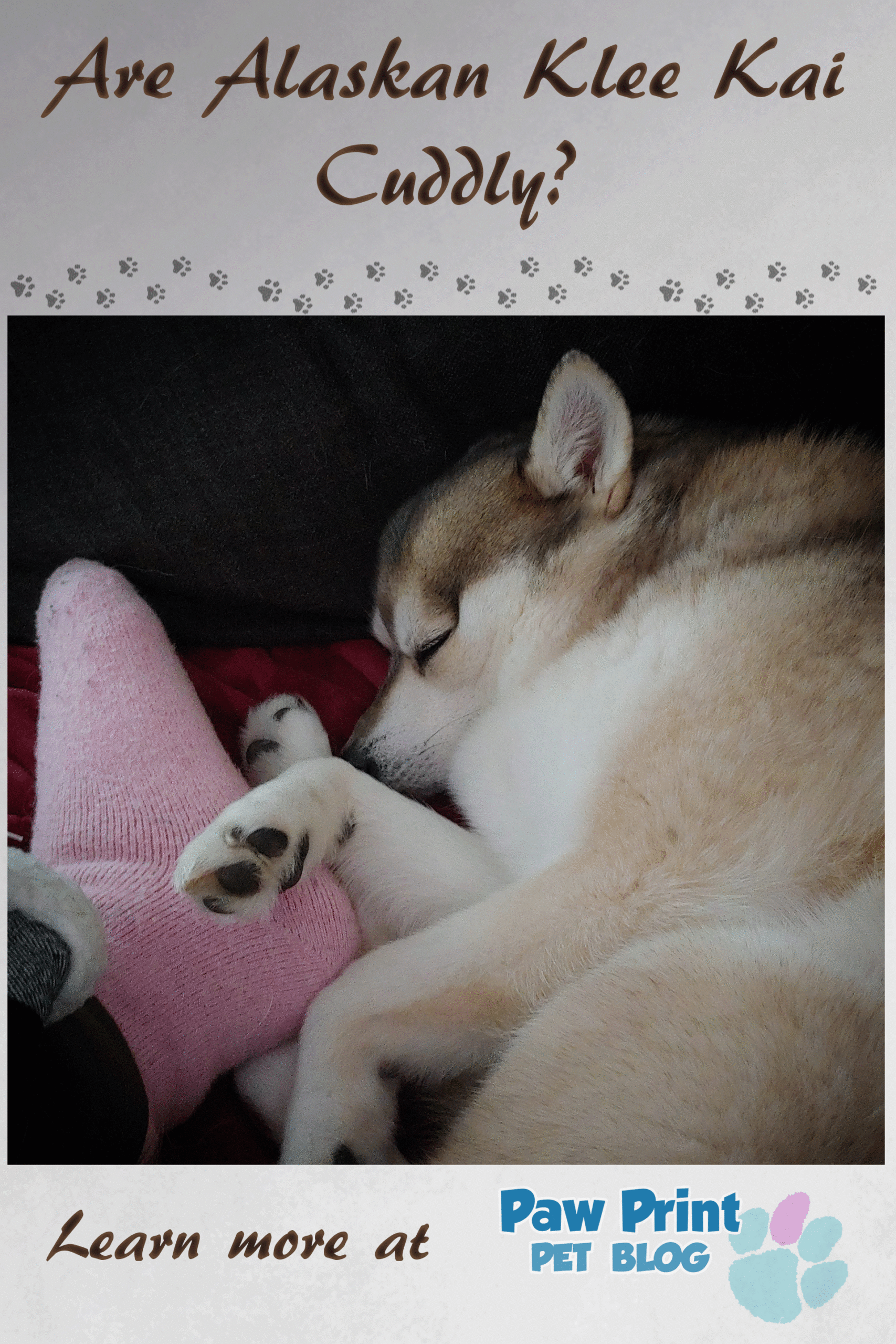

    That doesn’t mean, though, that he’s not affectionate in other ways with people besides me.  Although he doesn’t often snuggle with my partner, Fen still often initiates play and asks for ear scratches and belly rubs from my partner.

    Klee Cats?

    AKK are sometimes affectionately referred to as “Klee cats” due to their tendency to be quite cat like.  I see this most in my own AKK in his tendency to really only want attention on his own terms.  Snuggling has to be Fen’s idea for him to want to do it for any length of time.  He’ll snuggle with me all night sometimes, as long as he wants too.  But there are other times when, no matter how hard I try to convince him, he’d just rather not cuddly up next to me.

    Funny enough, even when Fen doesn’t feel like snuggling he’s still usually not far from my side.  But I’d for sure say that he can be more independent, when he wants to be, than my papillon Kitsune.

    One Size Doesn’t Fit All

    Of course dogs, even when they are the same breed, are not always the same.  Each dog is an individual!  I’m sure there are some AKK who are snuggle fiends, and others who don’t like to snuggle at all.  Most probably fall somewhere in-between those two extremes.  In general, other AKK owner’s who I’ve spoken with have said things similar to what I’ve written here.  That their AKK like to snuggle sometimes, especially so with their chosen person, but that these dogs also tend to be somewhat high energy as well as independent.  Traits that don’t always lend super well for long, drawn out snuggle sessions.

    Conclusions

    I love Alaskan Klee Kai.  However, they are a high maintenance breed that is not for everyone.  If getting a cuddly small dog is one of your number one requirements in a companion I’d suggest you think very carefully before getting an AKK.  While my own experience has been that my own AKK is pretty snuggly, he only cuddles with me.  I can see how that might be an issue in bigger families where everyone would appreciate some doggy snuggle time.  My AKK also really only snuggles with me on his own terms.  If it’s his idea, and he feels like cuddling, than great!  Otherwise, lets just say that I’m happy my other dog, a papillon, is super cuddly because if he wasn’t I probably wouldn’t be getting in my required dose of dog snuggles.  

    Comment below!  Is having a dog that likes to cuddle important to you?  Does your dog like to cuddle, or is he/she oftentimes more independent?

    Alaskan Klee Kai Cuddly

    We’ve, unfortunately, been dealing with content scrapers stealing our articles lately. You shouldn’t be seeing this article on any site other than pawprintpetblog.com! If you’re reading this article on any other site, we’d love for you to take the time to contact us and let us know and, if you have the time, stop by and visit us on our official site! Thanks you.

Older Posts
Newer Posts
It's a beautiful day to play ball in the snow ❄️ It's a beautiful day to play ball in the snow ❄️
Today would have been Kit's 17th birthday. My best Today would have been Kit's 17th birthday. My best buddy...not a single day goes by that I don't think of him. Forever a beloved member of our little pack ❤️
Someone stole his dad's socks 😂 10 years old and s Someone stole his dad's socks 😂 10 years old and still as mischievous as a pup!  This little one makes me laugh everyday and I'm SO thankful for him. 💙
New phone, who dis!? 😅 Sorry for the lack of new New phone, who dis!? 😅 
Sorry for the lack of new Fen pics lately... My old phone broke and it took me awhile to replace it. 
Fen is his happy, sassy, playful self and is doing well. 💙
Fen makes me laugh so much! Today is my partner's Fen makes me laugh so much! Today is my partner's birthday. ❤️ I almost always wake up earlier than him, so this morning I was planning on getting up to decorate for his birthday. I wanted to surprise him with decorations and his presents set out when he got up.

Well...Fenrir ruined it all, because as soon as he saw the wrapped presents for my partner, he got SO excited! And if you have ever had the pleasure of meeting an Alaskan Klee Kai you will know, when they get excited, they just have to make sure everyone knows about it!

Long story slightly shorter, Fen woke my partner up early, on his birthday, all because Fen REALLY wanted to open presents that weren't even for him! I didn't get to decorate, but lesson learned - don't put gifts where Fen can see them because he will get really, really excited about it.

And just so you all don't feel too bad for him...I ended up wrapping one of Fen's Christmas presents and giving it to him to open early! 🤣
Follow on Instagram
Facebook Instagram Pinterest Youtube

Copyright © 2025 Paw Print Pet Blog. All Rights Reserved.

Back to top